Animals / Mammal
Snow leopard
Panthera uncia · Felidae
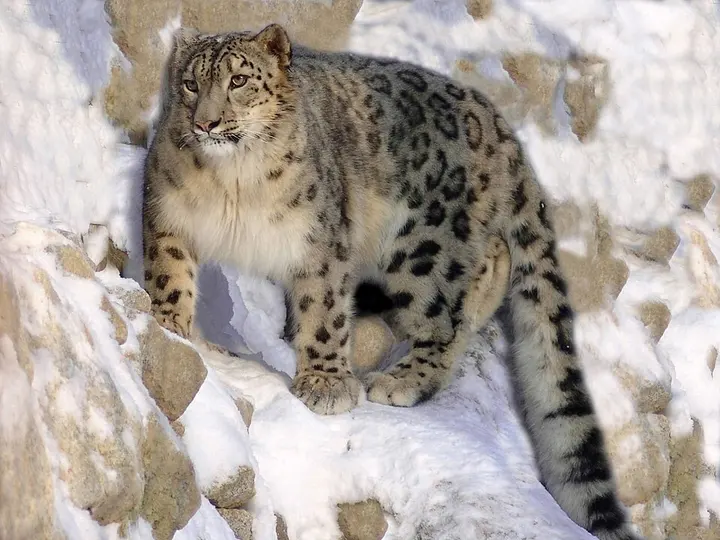
The snow leopard is a felid species in the genus Panthera. It has a thick whitish to grey fur with black spots on the head and neck, with larger rosettes on the back, flanks and bushy tail. Males are larger than the females, and both sexes have long canine teeth.
Its small rounded ears, broad paws, and thick tails are adaptations for living in cold, mountainous environments. The snow leopard is native to the mountain ranges of Asia, ranging from eastern Hindu Kush, the Himalayas and the Tibetan Plateau to southern Siberia, Mongolia and western China. It inhabits alpine and subalpine zones at elevations of 3,000–4,500 m (9,800–14,800 ft) featuring cliffs and ridges, but also lives at lower elevations in the northern part of its range. It is a solitary animal and is mostly active at dawn and twilight. It is a carnivore and actively hunts its prey, which include various ungulates and domestic livestock. The snow leopard was long classified in the monotypic genus Uncia.
Appearance
The snow leopard's fur is whitish to grey with black spots on the head and neck, with larger rosettes on the back, flanks and bushy tail. Its muzzle is short, its forehead domed, and its nasal cavities are large. The fur is thick with hairs measuring 5 to 12 cm (2.0 to 4.7 in) in length, and its underbelly is whitish.
Behaviour
The snow leopard is solitary and mostly active at dawn till early morning, and again in afternoons and early evenings. They mostly rest near cliffs and ridges that provide vantage points and shade. In Nepal's Shey Phoksundo National Park, the home ranges of five adult radio-collared snow leopards largely overlapped, though they rarely met. Their individual home ranges ranged from 12 to 39 km2 (4.6 to 15.1 sq mi).
Habitat
The snow leopard is distributed from the west of Lake Baikal through southern Siberia, in the Kunlun Mountains, Altai Mountains, Sayan and Tannu-Ola Mountains, in the Tian Shan, through Tajikistan, Kyrgyzstan, Uzbekistan and Kazakhstan to the Hindu Kush in eastern Afghanistan, Karakoram in northern Pakistan, in the Pamir Mountains, the Tibetan Plateau and in the high elevations of the Himalayas in India, Nepal and Bhutan.
Life cycle
Snow leopards become sexually mature at two to three years, and normally live for 15–18 years in the wild. In captivity they can live for up to 25 years. Oestrus typically lasts five to eight days, and males tend not to seek out another partner after mating, probably because the short mating season does not allow sufficient time. Paired snow leopards mate in the usual felid posture, from 12 to 36 times a day.
Where the Snow leopard lives
Recorded in India, China, Mongolia, Kyrgyzstan, Nepal, Russia, Pakistan and Kazakhstan (Asia).
Most records fall in Ladakh, Qinghai, Hovd, Himachal Pradesh, Ysyk-Köl and Chhattisgarh.
See the Snow leopard’s range on the globe
Conservation status
Vulnerable (VU). At risk: it could become endangered. Categories are the IUCN Red List as republished by GBIF.
Sources
The range is a density of 265 georeferenced GBIF records, shown on the continents where it is mainly recorded, not an expert-drawn map. Description from Wikipedia.