Animals / Mammal
Sloth bear
Melursus ursinus · Ursidae
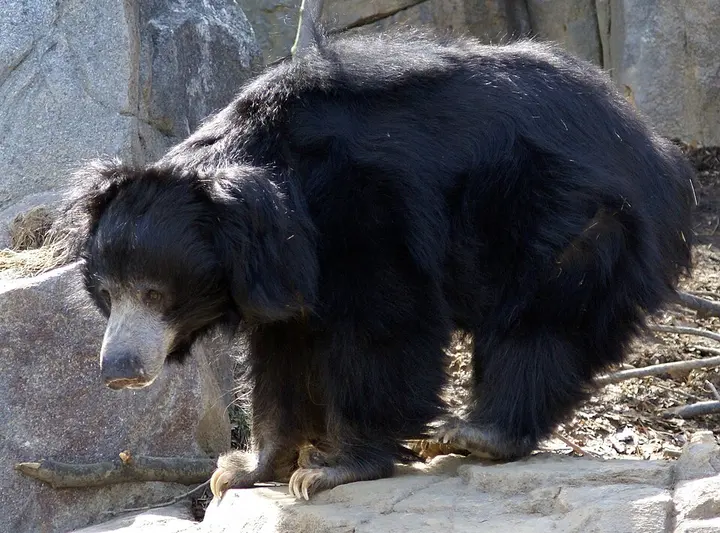
The sloth bear, also known as the Indian bear, is a myrmecophagous bear species native to the Indian subcontinent. It feeds on fruits, ants and termites. It is listed as vulnerable on the IUCN Red List, mainly because of habitat loss and degradation.
It is the only species in the genus Melursus. It has also been called "labiated bear" because of its long lower lip and palate used for sucking up insects. It has long, shaggy fur, a mane around the face, and long, sickle-shaped claws. It is lankier than brown and Asian black bears. It shares features of insectivorous mammals and evolved during the Pleistocene from the ancestral ursine bear through divergent evolution. Sloth bears breed during spring and early summer and give birth near the beginning of winter. When their territories are encroached upon by humans, they sometimes attack them. Historically, humans have drastically reduced these bears' habitat and diminished their population by hunting them for food and products such as their bacula and claws.
Appearance
Sloth bears adults are medium-sized bears. The typical weight range for females is from 55 to 105 kg (121 to 231 lb), and for males is from 80 to 145 kg (176 to 320 lb). Exceptionally large female specimens can reach 124 kg (273 lb) and males up to 192 kg (423 lb). The average weight of sloth bears from the nominate subspecies in Nepal was 95 kg (209 lb) in females and 114 kg (251 lb) in males.
Behaviour
Adult sloth bears may travel in pairs. Males are often observed to be gentle with cubs. They may fight for food. They walk in a slow, shambling motion, with their feet being set down in a noisy, flapping motion. They are capable of galloping faster than running humans. Although they appear slow and clumsy, both young and adult sloth bears are excellent climbers.
Habitat
The sloth bear's global range includes India, the Terai of Nepal, temperate climatic zones of Bhutan and Sri Lanka. It occurs in a wide range of habitats including moist and dry tropical forests, savannahs, scrublands and grasslands below 1,500 m (4,900 ft) on the Indian subcontinent, and below 300 m (980 ft) in Sri Lanka's dry forests. It is regionally extinct in Bangladesh.
Life cycle
The breeding season for sloth bears varies according to location: in India, they mate in April, May, and June, and give birth in December and early January, while in Sri Lanka, it occurs all year. Sows gestate for 210 days, and typically give birth in caves or in shelters under boulders. Litters usually consist of one or two cubs, or rarely three. Cubs are born blind, and open their eyes after four weeks.
Where the Sloth bear lives
Recorded in India, Sri Lanka and Nepal (Asia).
Most records fall in Tamil Nadu, Karnataka, Rajasthan, Anurādhapura, Madhya Pradesh and Narayani.
See the Sloth bear’s range on the globe
Conservation status
Vulnerable (VU). At risk: it could become endangered. Categories are the IUCN Red List as republished by GBIF.
Sources
The range is a density of 870 georeferenced GBIF records, shown on the continents where it is mainly recorded, not an expert-drawn map. Description from Wikipedia.