Animals / Mammal
Sitatunga
Tragelaphus spekii · Bovidae
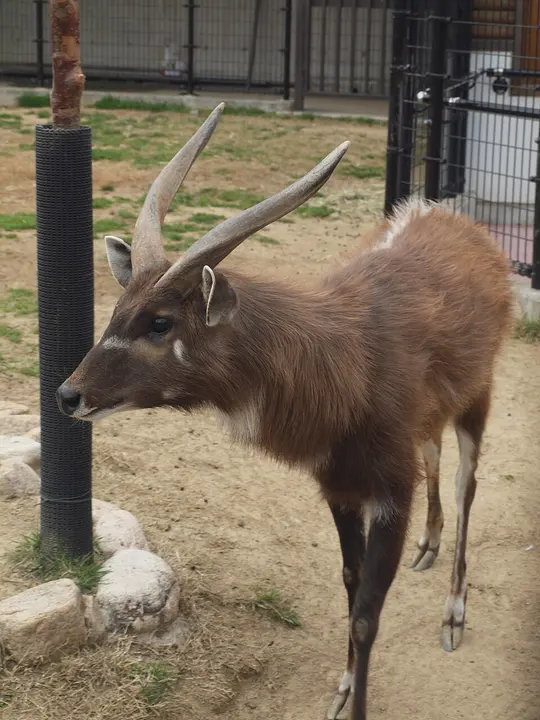
The sitatunga or marshbuck is a swamp-dwelling medium-sized antelope found throughout central Africa, centering on the Democratic Republic of the Congo, the Republic of the Congo, Cameroon, parts of Southern Sudan, Equatorial Guinea, Burundi, Ghana, Botswana, Rwanda, Zambia, Gabon, the Central African Republic, Tanzania, Uganda and Kenya. The sitatunga is mostly confined to swampy and marshy habitats. They occur in tall and dense vegetation as well as seasonal swamps, marshy clearings in forests, riparian thickets and mangrove swamps.
Appearance
The sitatunga is a medium-sized antelope. It is sexually dimorphic, with males considerably larger than females. The head-and-body length is typically between 136–177 cm (54–70 in) in males and 104–146 cm (41–57 in) in females. Males reach approximately 81–116 cm (32–46 in) at the shoulder, while females reach 72–90 cm (28–35 in). Males typically weigh 76–119 kg (168–262 lb), while females weigh 24–57 kg (53–126 lb). The tail is 14–37 cm (5.5–14.6 in) long.
Behaviour
Sitatunga are active mainly during the early hours after dawn, the last one or two hours before dusk, and at night, and spend a large part of this time feeding. Basically sedentary, they rest in flat areas and reed beds, especially during the hotter part of the day. They seldom leave their swamp habitat during the daytime. Though sitatunga commonly form pairs or remain solitary, larger groups have also been observed.
Habitat
The sitatunga is an amphibious antelope (meaning it can live on both land and water) confined to swampy and marshy habitats. They occur in tall and dense vegetation of perennial as well as seasonal swamps, marshy clearings in forests, riparian thickets and mangrove swamps. Sitatunga move along clearly marked tracks in their swampy habitat, often leading to reed beds. These tracks, up to 7 m (23 ft) wide, can lead to feeding grounds and nearby riverine forests.
Life cycle
Females are sexually mature by one year of age, while males take one-and-a-half-year before they mature. Breeding occurs throughout the year. When females gather, the males compete among each other for the right to mate, showing polygyny in males. The rutting male approaches the female in a lower bending posture, sniffing her vulva. The female may move slowly or react nervously.
Where the Sitatunga lives
Recorded in Benin, Gabon, Zambia, Botswana, Congo, Dem. Rep. Congo, Uganda, Tanzania, Cameroon, Rwanda and Namibia (Africa).
Most records fall in Atlantique, Haut-Ogooué, Central, Ouémé, North-West and Ogooué-Maritime.
See the Sitatunga’s range on the globe
Conservation status
Least concern (LC). Not at risk: it is doing well in the wild. Categories are the IUCN Red List as republished by GBIF.
Sources
The range is a density of 927 georeferenced GBIF records, shown on the continents where it is mainly recorded, not an expert-drawn map. Description from Wikipedia.