Animals / Insect
Seven-spot ladybird
Coccinella septempunctata · Coccinellidae
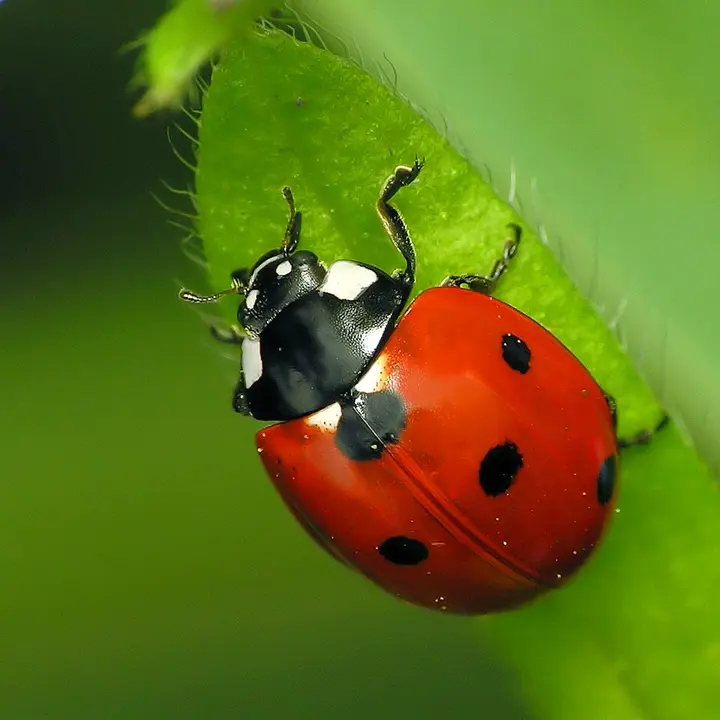
Coccinella septempunctata, commonly known as the seven-spot ladybird, often abbreviated C-7, is a carnivorous beetle native to Europe, most of Asia, and North Africa. It inhabits many regions with a temperate climate. The beetle has been introduced to several other areas, including North America as a biological pest control agent to combat aphid infestations.
It is one of approximately 5,000 species of ladybird worldwide. Tatia Bauer states that C. septempunctata's ability to adapt to many different habitats makes it "one of the most successful aphidophagous insects". C. septempunctata was first described and named in 1758 by the Swedish biologist Carl Linnaeus. Coccinella, the name of the genus, comes from the Latin coccineus for the colour "scarlet". The common name is reflected in the Latin name for the species, septem meaning "seven" and punctata meaning "spotted". C. septempunctata's elytra is red in colour, with three black spots on each wing. A further spot appears where the two wings join, giving a total of seven black spots. Their principal diet is aphids, on which they also depend for development and reproduction.
Appearance
The adult Coccinella septempunctata has an oval, convex shape. It has a body length of 6.5–7.8 mm (0.26–0.31 in) and a width of about 4 mm (0.16 in), with orange-red elytra (forewings) and seven black spots on the elytra. There is one black spot next to the beetle's scutellum where the two elytra meet. There are also two white patches on the elytra just ahead of this black spot. The remaining six black spots are distributed across the elytra, three on each.
Behaviour
Coccinella septempunctata has motility and can fly. It is active during the day and dormant at night. During hibernation, seven-spot ladybird adults gather in clusters for warmth and protection, and to ensure that when they exit diapause, they will already have potential mates for breeding. When preparing to hibernate, C. septempunctata emit a pheromone to attract other ladybirds to their overwintering site.
Diet
The adult and larval stages of Coccinella septempunctata feed on aphids, which are essential for their own development and reproduction. They consume at least twenty-four different species of aphid. Some aphid species, such as the lupin aphid (Macrosiphum albifrons), are harmful to seven-spot ladybirds. M. albifrons feed largely on alkaloid-rich lupin plants, and absorb compounds from the host plant that are toxic to some coccinellid species.
Where the Seven-spot ladybird lives
Recorded in United Kingdom, Netherlands, Germany, France, Belgium, Sweden, Spain, Ireland and Russia (Europe and North America).
Introduced, not native, in United States of America and Canada.
Most records fall in Zuid-Holland, Nordrhein-Westfalen, Noord-Brabant, California, Gelderland and Noord-Holland.
See the Seven-spot ladybird’s range on the globe
Conservation status
Not evaluated (NE). Scientists haven’t checked yet how at risk it is, so this doesn’t mean it is safe or in danger. Categories are the IUCN Red List as republished by GBIF.
Sources
The range is a density of 720,326 georeferenced GBIF records, shown on the continents where it is mainly recorded, not an expert-drawn map. Description from Wikipedia.