Animals / Mammal
Serval
Leptailurus serval · Felidae
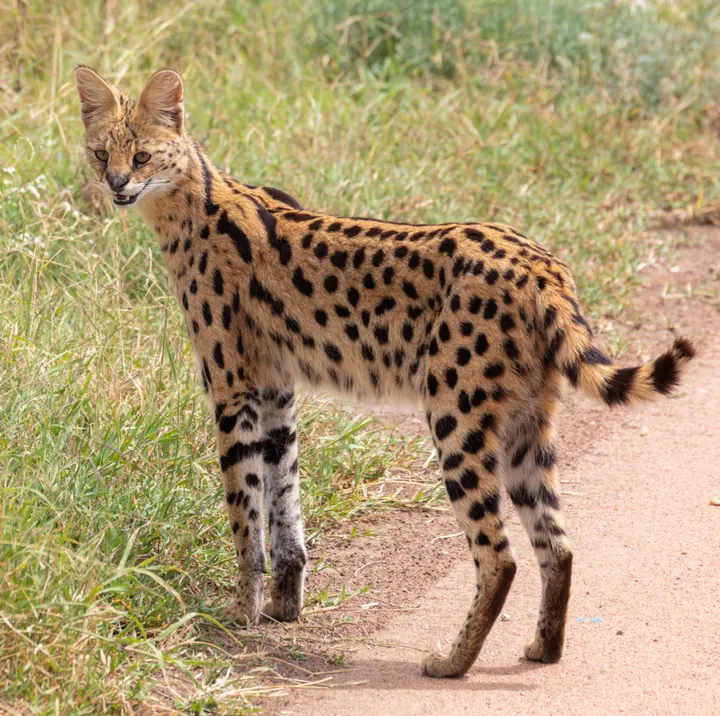
The serval is a wild small cat native to Africa. It is widespread in sub-Saharan countries, where it inhabits grasslands, wetlands, moorlands and bamboo thickets. Across its range, it occurs in protected areas, and hunting it is either prohibited or regulated in range countries.
It is the sole member of the genus Leptailurus. Three subspecies are recognised. The serval is a slender, medium-sized cat that stands 54–62 cm (21–24 in) tall at the shoulder and has a weight range of approximately 9–18 kg (20–40 lb). It is characterised by a small head, large ears, a golden-yellow to buff coat spotted and striped with black, and a short, black-tipped tail. The serval has the longest legs of any cat relative to its body size. The serval is a solitary carnivore and active both by day and at night. It preys on rodents, particularly vlei rats, small birds, frogs, insects, and reptiles, using its hearing to locate prey. It leaps over 2 m (6 ft 7 in) above the ground to land on the prey on its forefeet, and kills it with a bite to the neck or the head.
Appearance
The serval is a slender, medium-sized cat; it stands 54 to 62 cm (21–24 in) at the shoulder and weighs 8 to 18 kg (18–40 lb), but females tend to be lighter. The head-and-body length is typically between 67 and 100 cm (26–39 in). Males tend to be sturdier than females. Prominent characteristics include the small head, large ears, spotted and striped coat, long legs and a black-tipped tail that is around 30 cm (12 in) long.
Behaviour
The serval is active both in the day and at night; activity might peak in early morning, around twilight, and at midnight. Servals might be active for a longer time on cool or rainy days. During the hot midday, they rest or groom themselves in the shade of bushes and grasses. Servals remain cautious of their vicinity, though they may be less alert when no large carnivores or prey animals are around. Servals walk as much as 2 to 4 km (1.2 to 2.5 mi) every night.
Habitat
In North Africa, the serval is known only from Morocco and has been reintroduced in Tunisia, but is feared to be extinct in Algeria. It inhabits semi-arid areas and cork oak forests close to the Mediterranean Sea, but avoids rainforests and arid areas. It occurs in the Sahel, and is widespread in Southern Africa. It inhabits grasslands, moorlands, and bamboo thickets at high altitudes up to 3,800 m (12,500 ft) on Mount Kilimanjaro.
Life cycle
Both sexes become sexually mature when they are one to two years old. Oestrus in females lasts one to four days; it typically occurs once or twice a year, though it can occur three or four times a year if the mother loses her litters. Observations of captive servals suggest that when a female enters oestrus, the rate of urine-marking increases in her as well as the males in her vicinity.
Where the Serval lives
Recorded in South Africa, Tanzania, Kenya, Angola, Zambia, Dem. Rep. Congo, Benin, Ethiopia and Botswana (Africa).
Most records fall in Bengo, Rift Valley, Arusha, KwaZulu-Natal, Central and Mpumalanga.
See the Serval’s range on the globe
Conservation status
Least concern (LC). Not at risk: it is doing well in the wild. Categories are the IUCN Red List as republished by GBIF.
Sources
The range is a density of 2,104 georeferenced GBIF records, shown on the continents where it is mainly recorded, not an expert-drawn map. Description from Wikipedia.