Animals / Mammal
Sea otter
Enhydra lutris · Mustelidae
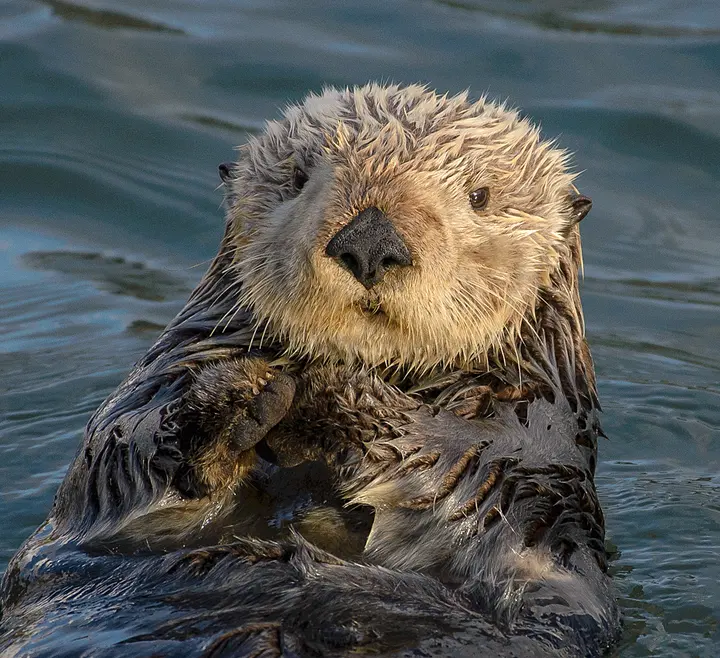
The sea otter is a marine mammal native to the coasts of the northern and eastern North Pacific Ocean. Adult sea otters typically weigh between 14 and 45 kg (30–100 lb), making them the heaviest members of the weasel family, but among the smallest marine mammals. Unlike most marine mammals, the sea otter's primary form of insulation is an exceptionally thick coat of fur, the densest in the animal kingdom.
Although it can walk on land, the sea otter is capable of living exclusively in the ocean. The sea otter inhabits nearshore environments, where it dives to the sea floor to forage. It preys mostly on marine invertebrates such as sea urchins, various mollusks and crustaceans, and some species of fish. Its foraging and eating habits are noteworthy in several respects. Its use of rocks to dislodge prey and to open shells makes it one of the few mammal species to use tools. In most of its range, it is a keystone species, controlling sea urchin populations which would otherwise inflict extensive damage to kelp forest ecosystems. Its diet includes prey species that are also valued by humans as food, leading to conflicts between sea otters and fisheries.
Appearance
The sea otter is one of the smallest marine mammal species. Male sea otters usually weigh 22 to 45 kg (49–99 lb) and are 1.2 to 1.5 m (47–59 in) in length, though specimens up to 54 kg (119 lb) have been recorded. Females are smaller, weighing 14 to 33 kg (31–73 lb) and measuring 1.0 to 1.4 m (39–55 in) in length.
Behaviour
The sea otter is diurnal. It has a period of foraging and eating in the morning, starting about an hour before sunrise, then rests or sleeps in mid-day. Foraging resumes for a few hours in the afternoon and subsides before sunset, and a third foraging period may occur around midnight. Females with pups appear to be more inclined to feed at night.
Diet
The sea otter hunts in short dives, often to the sea floor. Although it can hold its breath for up to five minutes, its dives typically last about one minute and not more than four minutes. It is the only marine animal capable of lifting and turning over rocks, which it often does with its front paws when searching for prey. The sea otter may also pluck snails and other organisms from kelp and dig deep into underwater mud for clams.
Life cycle
Sea otters are polygynous: males have multiple female partners, typically those that inhabit their territory. If no territory is established, they seek out females in estrus. When a male sea otter finds a receptive female, the two engage in playful and sometimes aggressive behavior. They bond for the duration of estrus, or 3 days. The male holds the female's head or nose with his jaws during copulation. Visible scars are often present on females from this behavior.
Where the Sea otter lives
Recorded in United States of America and Canada (North America).
Most records fall in California, Alaska, British Columbia and Washington.
See the Sea otter’s range on the globe
Conservation status
Endangered (EN). In danger of dying out in the wild. Categories are the IUCN Red List as republished by GBIF.
Sources
The range is a density of 25,179 georeferenced GBIF records, shown on the continents where it is mainly recorded, not an expert-drawn map. Description from Wikipedia.