Animals / Bird
Scarlet macaw
Ara macao · Psittacidae
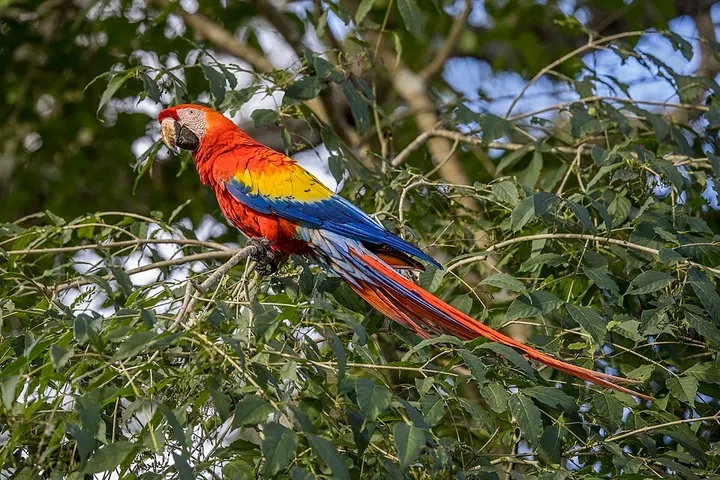
The scarlet macaw also called the red-and-yellow macaw, red-and-blue macaw or red-breasted macaw, is a large yellow, green, red and blue Neotropical parrot native to humid evergreen forests of the Americas. Its range extends from southeastern Mexico to Peru, Ecuador, Colombia, Bolivia, Venezuela, Honduras, and Brazil in lowlands of 500 m (1,600 ft) up to 1,000 m (3,300 ft), the Caribbean island of Trinidad, as well as the Pacific island of Coiba. Formerly, the northern extent of its range included southern Tamaulipas.
In some areas, it has suffered local extinction because of habitat destruction, or capture for the parrot trade, but in other areas, it remains fairly common. It is the national bird of Honduras. Like its relative the blue-and-yellow macaw, the scarlet macaw is a popular bird in aviculture as a result of its striking plumage. It is the third most common macaw species in captivity after the blue-and-yellow and red-and-green macaw respectively. In recent years it has become much rarer in captivity and much more expensive due to stricter laws, its price being higher than even red-and-green macaws.
Appearance
It is about 84 centimeters (33 in) long, of which more than half is the pointed, graduated tail typical of all macaws, though the scarlet macaw has a larger percentage of tail than the other large macaws. The average weight is about 1 kilogram (2 lb 3 oz).
Behaviour
A typical sighting is of a single bird or a pair flying above the forest canopy, though in some areas flocks can be seen. Field observations in Costa Rica found that scarlet macaws spend nearly all their time high in the forest canopy, usually more than 10 m above the ground, and are rarely seen near or on the ground, likely to reduce predation risk and because most of their food sources occur in the canopy. They often gather at clay licks.
Diet
Wild scarlet macaws feed on fruits, nuts, seeds, flowers and nectar. As with smaller parrot species, there are reports of their consumption of insects, larvae, and snails; however, this seems to be rare for macaws and is not a major component of their diet. Seeds of Cnidoscolus and Schizolobium are thought to be the main sources of protein for nestling scarlet macaws.
Habitat
The scarlet macaw inhabits primarily humid, lowland subtropical rain forests, open woodlands, river edges, and savannas. In some regions, they are known to periodically visit natural mineral deposits (or 'licks'), typically in areas rich in clay and sediment, which the macaws will eat for digestive purposes and to glean vital nutrients, including sodium and calcium.
Life cycle
While comparatively docile at most times of the year, scarlet macaws may be formidably aggressive during periods of breeding. Scarlet macaws are monogamous birds, with individuals remaining with one partner throughout their lives. The hen lays two or three white eggs in a large tree cavity. The female incubates the eggs for about five weeks, and the chicks fledge from the nest about 90 days after hatching and leave their parents about a year later.
Where the Scarlet macaw lives
Recorded in Costa Rica, Peru, Colombia, Brazil and Ecuador (North America and South America).
Most records fall in Puntarenas, San José, Madre de Dios, Alajuela, Mato Grosso and Guanacaste.
See the Scarlet macaw’s range on the globe
Conservation status
Least concern (LC). Not at risk: it is doing well in the wild. Categories are the IUCN Red List as republished by GBIF.
Sources
The range is a density of 153,302 georeferenced GBIF records, shown on the continents where it is mainly recorded, not an expert-drawn map. Description from Wikipedia.