Animals / Fish
Scalloped hammerhead
Sphyrna lewini · Sphyrnidae
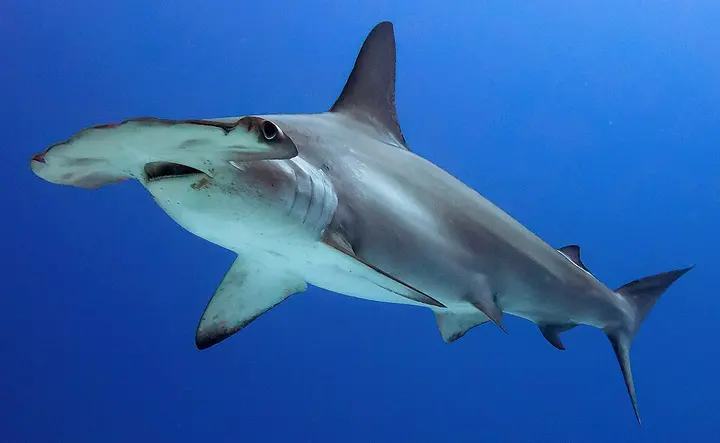
The scalloped hammerhead is a species of hammerhead shark in the family Sphyrnidae. It was originally known as Zygaena lewini. The Greek word sphyrna translates into "hammer" in English, referring to the shape of this shark's head, which is its most distinguishing characteristic.
The shark's eyes and nostrils are at the tips of the extensions. It is a fairly large hammerhead, but is still smaller than both the great and smooth hammerheads. This shark is also known as the bronze, kinky-headed, or southern hammerhead. It primarily lives in warm, temperate, and tropical coastal waters all around the globe between latitudes 46°N and 36°S, down to a depth of 500 m (1,600 ft). It is the most common of all hammerheads.
Appearance
The scalloped hammerhead is easily distinguished from other hammerhead sharks by the central indentation on the anterior margin of the head. There are also two indentations on either side of the central indentation, which gives the "scalloped" look. They have a very large first dorsal fin that is slightly hooked and a smaller second dorsal fin. Scalloped hammerhead sharks are typically uniform grey, grayish brown, bronze, or olive with a white underside for countershading.
Behaviour
These sharks are often seen during the night, day, and morning in big schools, sometimes numbering hundreds, most likely because large groups can obtain food more easily than singles or small groups, especially larger and trickier prey, as commonly seen. The younger the sharks, the closer to the surface they tend to be, while the adults are found much deeper in the ocean. They are not considered dangerous and are normally not aggressive towards humans.
Diet
Scalloped hammerheads are generalists and opportunistic predators, eating whatever is available and abundant in their area. There is no difference in what male and female sharks eat, but larger sharks are noted to eat larger prey than smaller, juvenile hammerheads. Juveniles typically feed on inshore fish, while adults feed on inshore fish as well as larger organisms that live in deeper waters.
Habitat
The scalloped hammerhead is a coastal pelagic species; it occurs over continental and insular shelves and in nearby deeper water. It is found in warm temperate and tropical waters, worldwide from 46°N to 36°S. It can be found down to depths over 500 m (1,600 ft), but is most often found above 25 m (82 ft). During the day, they are more often found close to shore, and at night, they hunt further offshore.
Life cycle
The gestation period is reported to be around 12 months. Scalloped hammerheads give live birth. Compared to other species, the scalloped hammerhead produces large litters (12–41 pups), and this is most likely due to high infant mortality. Like most sharks, parental care is not seen. Nursery grounds for this species are predictable and repeated over the years, and they are faithful to their natal sites.
Where the Scalloped hammerhead lives
Recorded in Ashmore and Cartier Is., Mexico, United States of America, Fiji, Ecuador, Colombia, Cameroon, Papua New Guinea and Brazil (Oceania, North America, South America and Africa).
Most records fall in Western Australia, Central, Chiapas, Queensland, Sinaloa and Northern Territory.
See the Scalloped hammerhead’s range on the globe
Conservation status
Critically endangered (CR). In very great danger of dying out in the wild. Categories are the IUCN Red List as republished by GBIF.
Sources
The range is a density of 10,104 georeferenced GBIF records, shown on the continents where it is mainly recorded, not an expert-drawn map. Description from Wikipedia.