Animals / Mammal
Sable antelope
Hippotragus niger · Bovidae
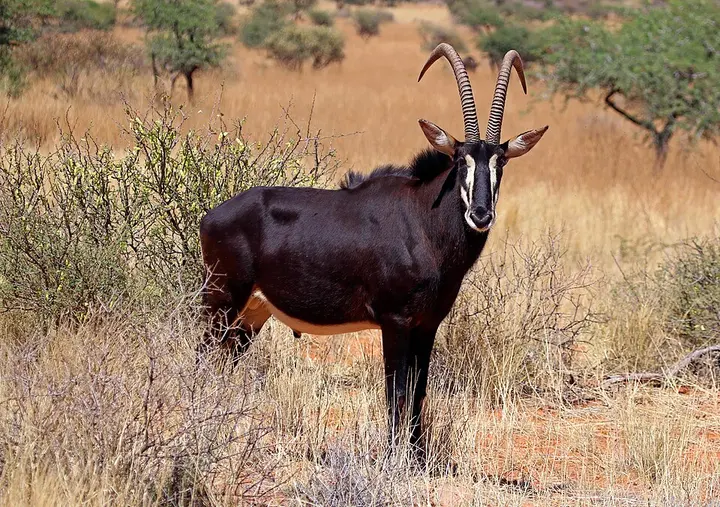
The sable antelope is a large antelope which inhabits wooded savanna in East and Southern Africa, from the south of Kenya to South Africa, with a separated population in Angola.
Appearance
The sable antelope is sexually dimorphic, with the male heavier and about one-fifth taller than the female. The head-and-body length is typically between 190 and 255 cm (75 and 100 in). Males reach about 117–140 cm (46–55 in) at the shoulder, while females are slightly shorter. Males typically weigh 235 kg (518 lb) and females 220 kg (490 lb). The tail is 40–75 cm (16–30 in) long, with a tuft at the end.
Behaviour
Sable antelopes live in savanna woodlands and grasslands during the dry season, where they eat mid-length grasses and leaves. They visit salt licks and have been known to chew bones to collect minerals. They are diurnal, but are less active during the heat of the day. They form herds of 10 to 30 females and calves led by a single male, called a bull. Males fight among themselves; they drop to their knees and use their horns.
Diet
Sable antelopes are herbivores. They are specialized browsing animals that feed upon foliage, mid-length grasses (primarily Urochloa nigropedata), leaves and herbs, particularly those that grow on termite mounds. Tree leaves make up 90% of their diet. They are diurnal animals, meaning they are most active in the daylight, but less active during the hottest part of the day. Like other bovids, they also have a ruminant digestive system.
Life cycle
The giant sable antelope's breeding season is seasonal and births coincide with the rainy season. After a gestation period of around 9 months, the female gives birth to a single young. A newborn calf is born with a sandy coloured coat, which helps it to camouflage. The calf will lie hidden away for at least 10 days while being nursed by its mother. Young sable antelope are weaned at around 8 months and will become sexually mature at between 2 and 3 years.
Where the Sable antelope lives
Recorded in South Africa, Zambia, Botswana, Namibia, Zimbabwe, Malawi and Kenya (Africa).
Most records fall in Central, North-West, Limpopo, Mpumalanga, Caprivi and Matabeleland North.
See the Sable antelope’s range on the globe
Conservation status
Least concern (LC). Not at risk: it is doing well in the wild. Categories are the IUCN Red List as republished by GBIF.
Sources
The range is a density of 2,438 georeferenced GBIF records, shown on the continents where it is mainly recorded, not an expert-drawn map. Description from Wikipedia.