Animals / Bird
Rüppell's vulture
Gyps rueppellii · Accipitridae
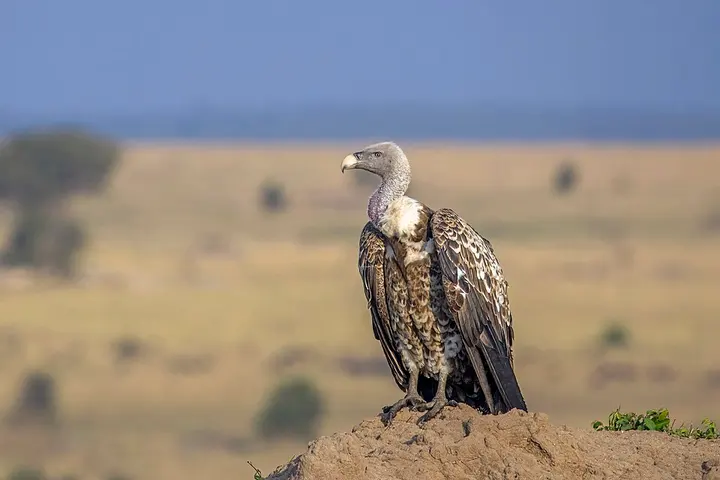
Rüppell's vulture, also called Rüppell's griffon vulture or Rüppell's griffon, a species of vulture named after Eduard Rüppell, is a large, resident bird of prey, mainly native to the Sahel region and East Africa. It is considered to be the highest-flying bird, with confirmed evidence of a flight at an altitude of 11,300 m (37,000 ft), where the average temperature is about −56 °C (−69 °F). The former population of 22,000 individuals has been decreasing due to loss of habitat, incidental poisoning, and other factors.
It is therefore listed as Critically Endangered on the IUCN Red List.
Appearance
The Rüppell's vulture is a very large vulture, noticeably outsizing the closely related white-backed vulture, with which they often occur in the wild. Adults are 85 to 103 cm (33 to 41 in) long, with a wingspan of 2.26 to 2.6 m (7 ft 5 in to 8 ft 6 in), and a weight that ranges from 6.4 to 9 kg (14 to 20 lb). Both sexes look alike: mottled brown or black overall with a whitish-brown underbelly and thin, dirty-white fluff covering the head and neck.
Behaviour
Ruppell's vulture cruises at a speed of 35 km/h (22 mph), but flies for 6–7 hours every day. In optimal soaring conditions, these birds can reach up to 45 km/h during cross-country flight and between 70 and 85 km/h during straight glides. They can travel well over 100 km (62 mi) from a nest site to find food, even reaching 200 km (120 mi) when using updrafts.
Diet
Strictly a carrion feeder, the Rüppell's vulture has been known to follow game herds on their seasonal migrations and feeds in large numbers at carcasses, usually with other Old World vulture species. Though it might take advantage of the remains of an animal killed by a lion, or other large predator, it can also feed on animals that have died from injuries, disease, or old age. Though they prefer freshly-killed meat, they can eat older carcasses without a problem.
Habitat
Since 1992, Rüppell's vulture has been occurring as a vagrant in Spain and Portugal, with annual records since 1997, mainly in the Cádiz and Strait of Gibraltar area, but also further north. In Morocco, it is a resident species, where some tagged populations have been seen to overwinter.
Life cycle
This species of vulture is considered to be monogamous, forming lifelong breeding pairs. After courtship the pair will work together to build a nest using sticks, grass, and leaves that they have gathered or stolen from other nests. Rüppell's vultures build these nests on cliffs, and in key breeding areas they are known to nest in large colonies containing hundreds of breeding pairs. Both parents share in incubation of their egg over a period of 55 days.
Where the Rüppell's vulture lives
Recorded in Kenya, Tanzania, Spain, Ethiopia, Uganda, Senegal and Gambia (Africa and Europe).
Most records fall in Rift Valley, Arusha, Cádiz, Oromiya, Mara and Simiyu.
See the Rüppell's vulture’s range on the globe
Conservation status
Critically endangered (CR). In very great danger of dying out in the wild. Categories are the IUCN Red List as republished by GBIF.
Sources
The range is a density of 24,123 georeferenced GBIF records, shown on the continents where it is mainly recorded, not an expert-drawn map. Description from Wikipedia.