Animals / Bird
Rose-ringed parakeet
Psittacula krameri · Psittacidae
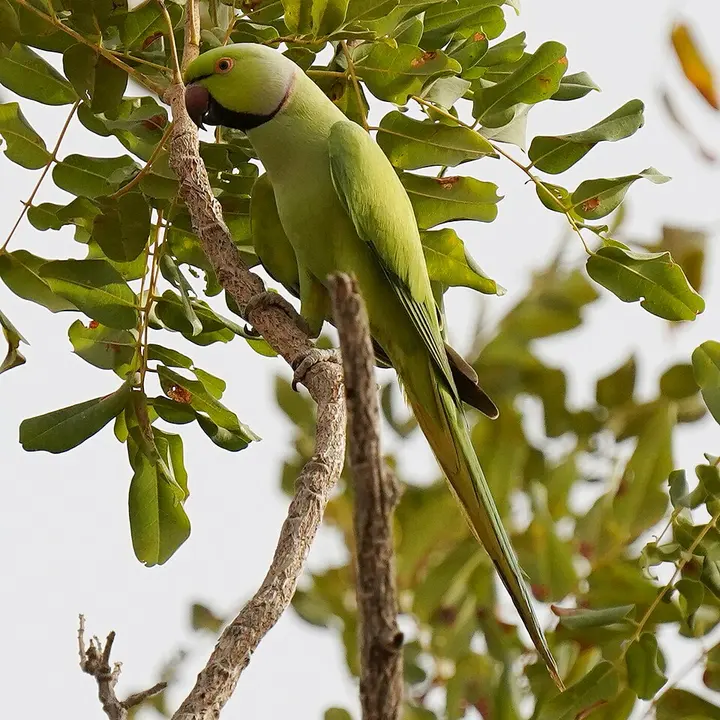
The rose-ringed parakeet, also known as the ring-necked parakeet, or colloquially as the Indian Ringneck, is a medium-sized parrot in the genus Psittacula, of the family Psittaculidae. It has a disjunct native range in tropical northern Africa and the Indian subcontinent, and is now introduced into many other parts of the world where populations have established themselves having been bred for the exotic pet trade and then escaped.
The species is listed as least concern by the International Union for Conservation of Nature (IUCN) because its population appears to be increasing, but its popularity as a pet and unpopularity with farmers have reduced its numbers in some parts of its native range. One of the few parrot species that have successfully adapted to living in disturbed habitats, it has withstood the onslaught of urbanisation and deforestation. As a popular pet species, escaped birds have colonised a number of cities around the world, including populations in northern and western Europe. They can live in a variety of climates outside their native range, and are able to survive low winter temperatures in northern Europe.
Appearance
Rose-ringed parakeets are 37–43 cm (15–17 in) in length, including the tail feathers, a large portion of their total length.
Behaviour
In the wild, rose-ringed parakeets usually feed on buds, nectar, fruit, vegetables, nuts, berries, seeds, grains, and insects. Wild flocks also fly several miles to forage in farmlands and orchards, causing extensive damage. Feral parakeets will regularly visit gardens and other locations near human habitation, taking food from bird feeders. In India, they feed on cereal grains, and during winter also on pigeon peas.
Diet
In the wild, rose-ringed parakeets usually feed on buds, nectar, fruit, vegetables, nuts, berries, seeds, grains, and insects. Wild flocks also fly several miles to forage in farmlands and orchards, causing extensive damage. Feral parakeets will regularly visit gardens and other locations near human habitation, taking food from bird feeders. In India, they feed on cereal grains, and during winter also on pigeon peas.
Habitat
In Africa, the species occurs in a narrow belt across the full width of the continent between about 4° to 17° N latitude, roughly coinciding with the Sudanian savannas; and in Asia in the Indian subcontinent and Sri Lanka from 6° to 35° N latitude in the foothills of the Himalaya, and from the Indus River valley in Pakistan east to the Irrawaddy River valley in Myanmar.
Life cycle
In northwestern India, Indian rose-ringed parakeets form pairs from September to December. They do not have life partners, and often breed with another partner during the following breeding season. During this cold season, they select and defend nest sites, thus avoiding competition for sites with other birds. Feeding on winter pea crops provides the female with nutrients necessary for egg production. From April to June, they care for their young.
Where the Rose-ringed parakeet lives
Recorded in India and Sri Lanka (Asia and Europe).
Introduced, not native, in United Kingdom, Belgium, Netherlands, Israel, France, Spain and Germany.
Most records fall in Karnataka, Tamil Nadu, Maharashtra, Kerala, Zuid-Holland and Gujarat.
See the Rose-ringed parakeet’s range on the globe
Conservation status
Least concern (LC). Not at risk: it is doing well in the wild. Categories are the IUCN Red List as republished by GBIF.
Sources
The range is a density of 1,960,449 georeferenced GBIF records, shown on the continents where it is mainly recorded, not an expert-drawn map. Description from Wikipedia.