Animals / Mammal
Rock hyrax
Procavia capensis · Procaviidae
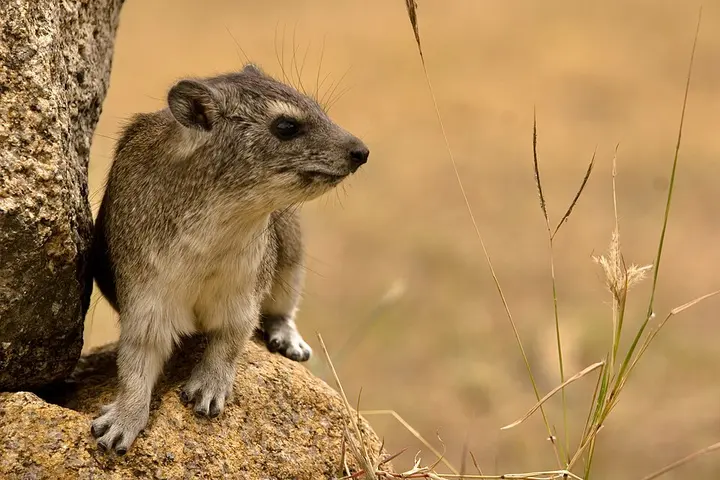
The rock hyrax, also called dassie, Rickaz, Cape hyrax, rock rabbit, or coney, is a medium-sized terrestrial hyrax native to Africa and the Middle East. Commonly called the dassie in South Africa, it is one of the five living species of the order Hyracoidea, and the only one in the genus Procavia. Rock hyraxes weigh 4–5 kg (8.8–11.0 lb) and have short ears.
Rock hyraxes are found at elevations up to 4,200 m (13,800 ft) above sea level in habitats with rock crevices, allowing them to escape from predators. They are the only extant terrestrial afrotherians in the Middle East. Hyraxes typically live in groups of 10–80 animals, and forage as a group. They have been reported to use sentries to warn of the approach of predators. Having incomplete thermoregulation, they are most active in the morning and evening, although their activity pattern varies substantially with season and climate. Over most of its range, the rock hyrax is not endangered, and in some areas is considered a minor pest.
Appearance
Rock hyraxes are squat and heavily built, with adults reaching a length of 50 cm (20 in) and weighing around 4 kg (8.8 lb), with a slight sexual dimorphism, males being about 10% heavier than females. Their fur is thick and grey-brown, although this varies strongly between different environments, from dark brown in wetter habitats, to light gray in desert-living individuals.
Behaviour
Rock hyraxes build dwelling holes in any type of rock with suitable cavities, such as sedimentary rocks and soil. In Mount Kenya, rock hyraxes live in colonies comprising an adult male, several adult females, and immatures. They are active during the day, and sometimes during moonlit nights. The dominant male defends and watches over the group. The male also marks his territory.
Life cycle
Rock hyraxes give birth to two to four young after a gestation period of 6–7 months (long, for their size). The young are well developed at birth with fully opened eyes and complete pelage. Young can ingest solid food after two weeks and are weaned at 10 weeks. After 16 months, they become sexually mature, they reach adult size at 3 years, and they typically live about 10 years.
Where the Rock hyrax lives
Recorded in Israel, South Africa, Namibia, Kenya and Tanzania (Asia and Africa).
Most records fall in Western Cape, HaZafon, HaDarom, HaMerkaz, Northern Cape and Jerusalem.
See the Rock hyrax’s range on the globe
Conservation status
Least concern (LC). Not at risk: it is doing well in the wild. Categories are the IUCN Red List as republished by GBIF.
Sources
The range is a density of 15,095 georeferenced GBIF records, shown on the continents where it is mainly recorded, not an expert-drawn map. Description from Wikipedia.