Animals / Bird
Rock dove
Columba livia · Columbidae
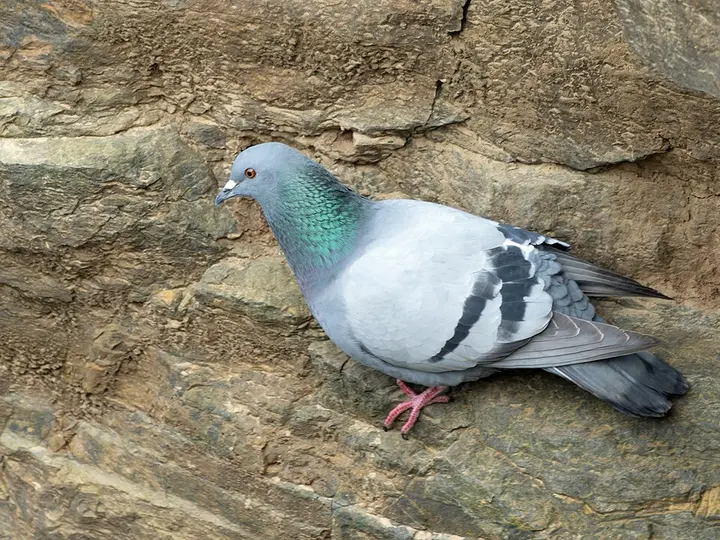
The rock dove, also known as the common pigeon or rock pigeon, is a member of the bird family Columbidae. In common usage, it is often simply referred to as the "pigeon", although the rock dove is the wild form of the bird; the pigeons familiar to most people are the domesticated forms of the wild rock dove.
Wild rock doves are uniformly pale grey with two black bars on each wing, with few differences being seen between males and females; i.e. they are not strongly sexually dimorphic. The domestic pigeon, often called "Columba livia domestica", which includes about 1,000 different breeds, is descended from this species. Escaped domestic pigeons are the origin of feral pigeons around the world. Both forms can vary widely in the colour and pattern of their plumage unlike their wild ancestor, being red, brown, checkered, uniformly coloured, or pied. Habitats include various open and semi-open environments where they are able to forage on the ground. Cliffs and rock ledges are used for roosting and breeding in the wild.
Appearance
Millennia of domestication have greatly altered the rock dove in many regions. Domestic and Feral pigeons, which arose through selective breeding, not originating naturally, have significant variation in plumage from the natural wild birds. This wild type is endangered in many areas; the nominate subspecies C. l. livia persists most notably in the far north and west of Scotland, most strongly so in the Outer Hebrides.
Behaviour
The call is a soft, slightly wavering, coo "crruoo-u", similar to feral pigeons. Variations include an alarm call, a nest call, and noises made by juveniles. When displaying, songs are partly sexual, partly threatening. They are accompanied by an inflated throat, tail fanning, strutting, and bowing. The alarm call, given at sight of predators, is a grunt-like oorhh.
Diet
Rock doves are omnivorous, but prefer plant matter: chiefly fruit and grains. Pigeons feed on the ground in flocks or individually. Pigeon groups typically consist of "producers", which scout out food sources, and "scroungers", which follow the producers and feed on food located by them. Generally, groups of pigeons contain a greater proportion of scroungers than producers. Pigeons are naturally granivorous, eating seeds that fit down their gullet.
Habitat
The natural distribution of the rock dove is restricted to a resident range in western and southern Europe, North Africa, and extending into South Asia. They were introduced into most of the rest of the world aboard European ships from 1603 onwards. When including feral birds, the species has a very large range, with an estimated global extent of occurrence of 10,000,000 km2 (3,900,000 sq mi).
Where the Rock dove lives
Recorded in India, United Kingdom, Spain, Sweden, Portugal and France (North America, Asia, Europe and Oceania).
Introduced, not native, in United States of America, Canada and Ashmore and Cartier Is..
Most records fall in California, New York, Québec, Ontario, Texas and Washington.
See the Rock dove’s range on the globe
Conservation status
Least concern (LC). Not at risk: it is doing well in the wild. Categories are the IUCN Red List as republished by GBIF.
Sources
The range is a density of 15,615,228 georeferenced GBIF records, shown on the continents where it is mainly recorded, not an expert-drawn map. Description from Wikipedia.