Animals / Mammal
Roan antelope
Hippotragus equinus · Bovidae
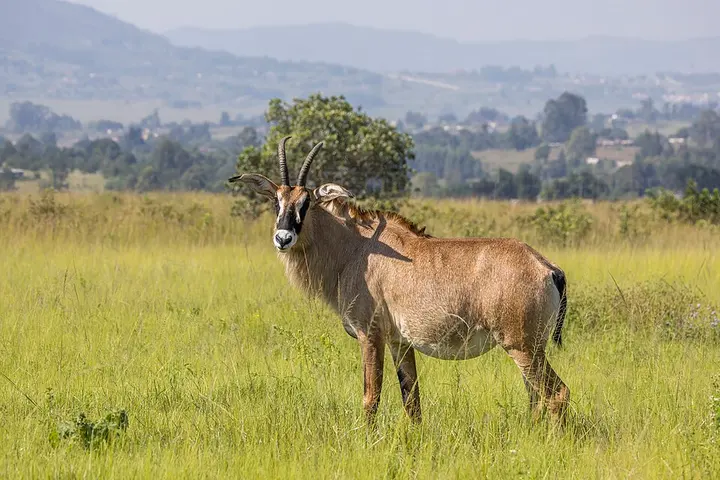
The roan antelope is a large, savanna-dwelling antelope found in Western, Southern, and parts of Central and Eastern Africa. Named for its roan colour, it has a lighter-toned underbelly and a (mostly) white face and snout, but with a black "mask" around the eyes and on the bridge of the snout, being somewhat lighter in females. Additionally, a pair of formidable, recurved horns are present on the heads of both males and females, albeit larger on the males, growing up to 100 cm long.
Males and females have short, erect, mohawk-like manes running down their back and very light, shaggy neckbeards, both of which are more pronounced in males. Both mane and neckbeard are tinted with darker tips, which run the length of the animal's back and belly, ending in a dark-coloured tail. The ears are long, erect, and donkey-like. The roan is among the world's largest antelopes, after the elands (Taurotragus sp.) and the nilgai (Boselaphus tragocamelus), measuring 190–240 cm (75–94 in) from the head to the base of the tail, with a 37–48 cm (15–19 in)-long tail. Males weigh upwards of 242–300 kg (534–661 lb) and females 223–280 kg (492–617 lb), with a shoulder height of around 130–140 cm (51–55 in).
Appearance
The roan antelope is a large antelope with a horse-like build. It is the largest antelope in the genus Hippotragus, and one of the largest species of antelopes in the world. Only elands, bongos and large male greater kudus can exceed them in weight on average. The roan antelope stands 135–160 centimetres (53–63 in) at the shoulder, and weighs 230–320 kilograms (510–710 pounds). The head-and-body length is typically between 235 and 285 centimetres (93 and 112 inches).
Behaviour
Roan antelopes can be found in woodland, grassland, and savannah; mainly in the tropical and subtropical grasslands, savannas, and shrublands biome, which range in tree density from forest with a grassy understory (such as the central Zambezian Miombo woodlands) to grasslands dotted with few trees, where they eat mid-length grasses. They live in small groups and form harem groups of 5 to 15 animals with one dominant male.
Where the Roan antelope lives
Recorded in Benin, South Africa, Namibia, Botswana, Niger, Senegal, Burkina Faso, Zambia and Malawi (Africa).
Most records fall in Alibori, Atakora, Northern Cape, North-West, Limpopo and Tillabéri.
See the Roan antelope’s range on the globe
Conservation status
Least concern (LC). Not at risk: it is doing well in the wild. Categories are the IUCN Red List as republished by GBIF.
Sources
The range is a density of 4,982 georeferenced GBIF records, shown on the continents where it is mainly recorded, not an expert-drawn map. Description from Wikipedia.