Animals / Mammal
Ring-tailed lemur
Lemur catta · Lemuridae
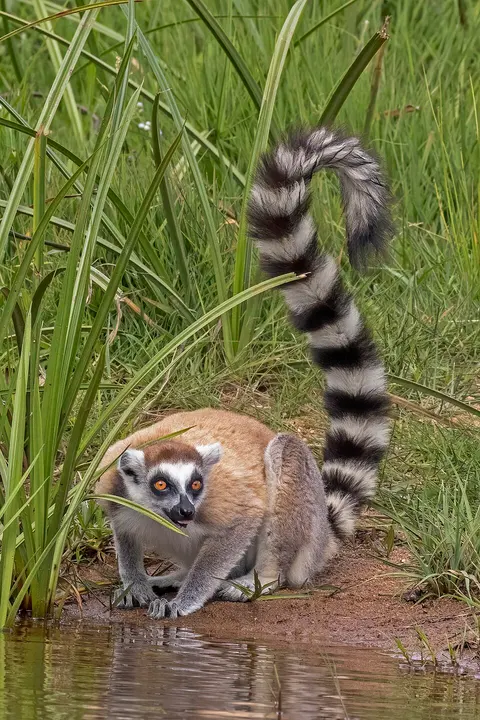
The ring-tailed lemur is a medium- to larger-sized strepsirrhine (wet-nosed) primate and the most internationally recognized lemur species, owing to its long, black-and-white, ringed tail. It belongs to Lemuridae, one of five lemur families, and is the only member of the Lemur genus. Like all lemurs, it is endemic to the island of Madagascar, where it is endangered.
Known locally in Malagasy as maky ([makʲ], spelled maki in French) or hira, it ranges from gallery forests to spiny scrub in the southern regions of the island. It is omnivorous, as well as the most adapted to living terrestrially of the extant lemurs. The ring-tailed lemur is highly social, living in groups—known as "troops"—of up to 30 individuals. It is also a female-dominant species, a commonality among lemurs. To keep warm and reaffirm social bonds, groups will huddle together. Mutual grooming is another vital aspect of lemur socialization (as with all primates), reaffirming social and familial connections, while also helping rid each other of any potential insects. Ring-tailed lemurs are strictly diurnal, being active exclusively during daylight hours.
Appearance
The ring-tailed lemur is a relatively large lemur. Its average weight is 2.2 kilograms (4.9 lb). Its head–body length ranges between 39 and 46 cm (15 and 18 in), its tail length is 56 and 63 cm (22 and 25 in), and its total length is 95 and 110 cm (37 and 43 in). Other measurements include a hind foot length of 102 and 113 mm (4.0 and 4.4 in), ear length of 40 and 48 mm (1.6 and 1.9 in), and cranium length of 78 and 88 mm (3.1 and 3.5 in).
Behaviour
The ring-tailed lemur is diurnal and semi-terrestrial. It is the most terrestrial of lemur species, spending as much as 33% of its time on the ground. However it is still considerably arboreal, spending 23% of its time in the mid-level canopy, 25% in the upper-level canopy, 6% in the emergent layer and 13% in small bushes. Troop travel is 70% terrestrial. Troop size, home range, and population density vary by region and food availability.
Diet
The ring-tailed lemur is an opportunistic omnivore primarily eating fruits and leaves, particularly those of the tamarind tree (Tamarindus indica), known natively as kily. When available, tamarind makes up as much as 50% of the diet, especially during the dry, winter season. The ring-tailed lemur eats from as many as three dozen different plant species, and its diet includes stems, flowers, herbs, bark and exudates (latex, resin and sap).
Where the Ring-tailed lemur lives
Recorded in Madagascar (Africa).
Most records fall in Haute Matsiatra, Ihorombe, Anosy, Atsimo-Andrefana, Itasy and Bongolava.
See the Ring-tailed lemur’s range on the globe
Conservation status
Endangered (EN). In danger of dying out in the wild. Categories are the IUCN Red List as republished by GBIF.
Sources
The range is a density of 909 georeferenced GBIF records, shown on the continents where it is mainly recorded, not an expert-drawn map. Description from Wikipedia.