Animals / Bird
Ring-billed gull
Larus delawarensis · Laridae
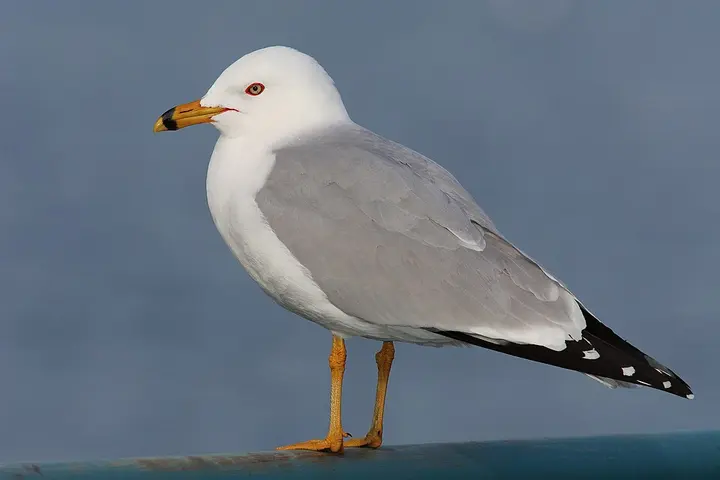
The ring-billed gull is a medium-sized gull native to North America, breeding in Canada and the northern Contiguous United States, and wintering mainly in the United States and northern Mexico. The genus name is from Latin Larus which appears to have referred to a gull or other large seabird. The specific delawarensis refers to the Delaware River.
Appearance
The ring-billed gull is a medium-sized gull, having an average length of 43 to 54 centimetres (16.9 to 21.3 in) and a wingspan that ranges from 105 to 117 centimetres (41.3 to 46.1 in). Adults weigh from 300 to 700 grams (10.6 to 24.7 oz). The head, neck and underparts are white; the relatively short bill is yellow with a black ring; the back and wings are silver grey with black wingtips with white 'mirrors'; and the legs are yellow. The eyes are yellow with red rims.
Diet
Ring-billed gulls forage in flight or pick up objects while swimming, walking or wading. They also steal food from other birds and frequently scavenge. They are omnivorous; their diet may include insects, fish, grain, eggs, earthworms and rodents. These birds are opportunistic and have adapted well to taking food when discarded or even left unattended by people.
Habitat
The breeding habitat is near lakes, rivers, or the coast across most of Canada, and the northern United States. They nest colonially on the ground, often on islands, but also increasingly on flat factory roofs. This bird tends to be faithful to its nesting site, if not its mate, from year to year. The ring-billed gull is a familiar sight in North American parking lots, where it can regularly be found congregating in large numbers.
Where the Ring-billed gull lives
Recorded in United States of America and Canada (North America).
Most records fall in Ontario, Québec, New York, California, Michigan and Illinois.
See the Ring-billed gull’s range on the globe
Conservation status
Least concern (LC). Not at risk: it is doing well in the wild. Categories are the IUCN Red List as republished by GBIF.
Sources
The range is a density of 11,233,826 georeferenced GBIF records, shown on the continents where it is mainly recorded, not an expert-drawn map. Description from Wikipedia.