Animals / Mammal
Reindeer
Rangifer tarandus · Cervidae
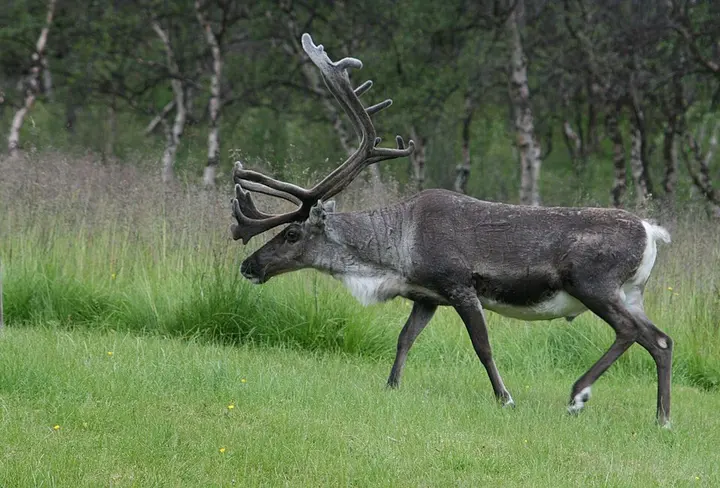
The reindeer or caribou is a species of deer with circumpolar distribution, native to Arctic, subarctic, tundra, boreal, and mountainous regions of Northern Europe, Siberia, and North America. It is the only representative of the genus Rangifer. More recent studies suggest the splitting of reindeer and caribou.
"All caribou and reindeer throughout the world are considered to be the same species, but there are 7 subspecies." Reindeer occur in both migratory and sedentary populations, and their herd sizes vary greatly in different regions. The tundra subspecies are adapted for extreme cold, and some are adapted for long-distance migration. Reindeer vary greatly in size and color from the smallest, the Svalbard reindeer (R. (t.) platyrhynchus), to the largest, Osborn's caribou (R. t. osborni). Although reindeer are quite numerous, some species and subspecies are in decline and considered vulnerable. They are unique among deer (Cervidae) in that females may have antlers, although the prevalence of antlered females varies by subspecies.
Appearance
Names follow international convention before the recent revision (see Reindeer § Taxonomy below). Reindeer / caribou (Rangifer) vary in size from the smallest, the Svalbard reindeer (R. (t.) platyrhynchus), to the largest, Osborn's caribou (R. t. osborni). They also vary in coat color and antler architecture.
Behaviour
Originally, the reindeer was found in Scandinavia, Eastern Europe, Greenland, Russia, Mongolia and northern China north of the 50th latitude. In North America, it was found in Canada, Alaska, and the northern contiguous United States from Maine to Washington. In the 19th century, it was still present in southern Idaho.
Diet
Reindeer are ruminants, having a four-chambered stomach. They mainly eat lichens in winter, especially reindeer lichen (Cladonia rangiferina); they are the only large mammal able to metabolize lichen. Many lichens synthesize toxic phenolic compounds, such as usnic acid, that protect them from UV radiation and herbivory. Reindeer can eat lichen because their rumen contains a reindeer-specific bacterium called Eubacterium rangiferina.
Habitat
Originally, the reindeer was found in Scandinavia, Eastern Europe, Greenland, Russia, Mongolia and northern China north of the 50th latitude. In North America, it was found in Canada, Alaska, and the northern contiguous United States from Maine to Washington. In the 19th century, it was still present in southern Idaho.
Life cycle
Reindeer mate in late September to early November, and the gestation period is about 228–234 days. During the mating season, bulls battle for access to cows. Two bulls will lock each other's antlers together and try to push each other away. The most dominant bulls can collect as many as 15–20 cows to mate with. A bull will stop eating during this time and lose much of his body fat reserves.
Where the Reindeer lives
Recorded in Norway, United States of America, Canada, Sweden, Finland and Russia (Europe and North America).
Introduced, not native, in Iceland.
Most records fall in Oppland, Hedmark, Sør-Trøndelag, Alaska, Svalbard and Møre og Romsdal.
See the Reindeer’s range on the globe
Conservation status
Vulnerable (VU). At risk: it could become endangered. Categories are the IUCN Red List as republished by GBIF.
Sources
The range is a density of 62,738 georeferenced GBIF records, shown on the continents where it is mainly recorded, not an expert-drawn map. Description from Wikipedia.