Animals / Bird
Red-winged blackbird
Agelaius phoeniceus · Icteridae
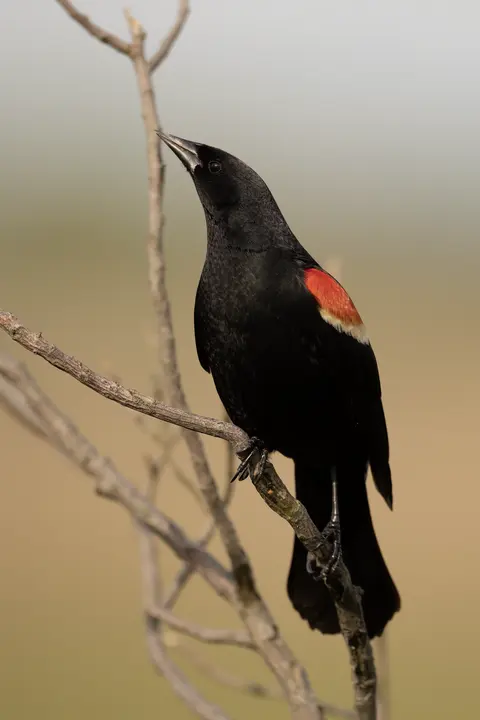
The red-winged blackbird is a passerine bird of the family Icteridae found in most of North America and much of Central America. It breeds from Alaska and Newfoundland south to Florida, the Gulf of Mexico, Mexico, and Guatemala, with isolated populations in western El Salvador, northwestern Honduras, and northwestern Costa Rica. It may winter as far north as Pennsylvania and British Columbia, but northern populations are generally migratory, moving south to Mexico and the Southern United States.
Claims have been made that it is the most abundant living land bird in North America, as bird-counting censuses of wintering red-winged blackbirds sometimes show that loose flocks can number in excess of a million birds per flock and the full number of breeding pairs across North and Central America may exceed 250 million in peak years. It also ranks among the best-studied wild bird species in the world. The red-winged blackbird is sexually dimorphic; the male is all black with a red shoulder and yellow wing bar, while the female is a nondescript dark brown. Seeds and insects make up the bulk of the red-winged blackbird's diet.
Appearance
The common name for the red-winged blackbird is taken from the mainly black adult male's distinctive red shoulder patches, or epaulets, which are visible when the bird is flying or displaying. At rest, the male also shows a pale yellow wingbar. The spots of males less than one year old, generally subordinate, are smaller and more orange than those of adults. The female is blackish-brown and paler below.
Behaviour
The calls of the red-winged blackbird are a throaty check and a high slurred whistle, terrr-eeee. The male's song, accompanied by a display of his red shoulder patches, is a scratchy oak-a-lee, except that in many western birds, including bicolored blackbirds, it is ooPREEEEEom. The female also sings, typically a scolding chatter chit chit chit chit chit chit cheer teer teer teerr.
Diet
The red-winged blackbird is omnivorous. It feeds primarily on plant materials, including seeds from weeds and waste grain such as corn and rice, but about a quarter of its diet consists of insects and other small animals, and considerably more so during breeding season. It prefers insects, such as dragonflies, damselflies, butterflies, moths, and flies, but also consumes snails, frogs, eggs, carrion, worms, spiders and mollusks.
Habitat
The red-winged blackbird is widely spread throughout North America, except in the arid desert, high mountain ranges, and arctic or dense afforestation regions. It breeds from central-eastern Alaska and Yukon in the northwest, and Newfoundland in the northeast, to northern Costa Rica in the south, and from the Atlantic to the Pacific. Northern populations migrate to the southern United States, but those that breed there, in Mexico, and in Central America are sedentary.
Where the Red-winged blackbird lives
Recorded in United States of America and Canada (North America).
Most records fall in Ontario, New York, California, Texas, Québec and Michigan.
See the Red-winged blackbird’s range on the globe
Conservation status
Least concern (LC). Not at risk: it is doing well in the wild. Categories are the IUCN Red List as republished by GBIF.
Sources
The range is a density of 21,124,700 georeferenced GBIF records, shown on the continents where it is mainly recorded, not an expert-drawn map. Description from Wikipedia.