Animals / Bird
Red-tailed hawk
Buteo jamaicensis · Accipitridae
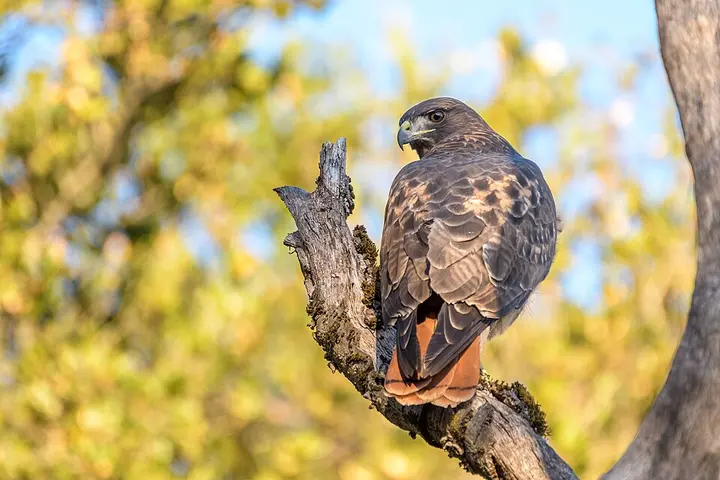
The red-tailed hawk is a bird of prey and one of the most common hawks in North America. In the United States, it is one of three species colloquially known as the "chickenhawk". The red-tailed hawk breeds throughout most of the continent, from western Alaska and northern Canada to as far south as Panama and the West Indies.
The red-tailed hawk occupies a wide range of habitats and altitudes, including deserts, grasslands, coniferous and deciduous forests, agricultural fields, and urban areas. It is absent in areas of unbroken forest and in the high arctic. It is legally protected in Canada, Mexico, and the United States by the Migratory Bird Treaty. The red-tailed hawk is one of the largest members of the genus Buteo in North America, typically weighing from 690 to 1,600 g (1.5 to 3.5 lb) and measuring 45–65 cm (18–26 in) in length, with a wingspan from 110–145 cm (43–57 in). Females are about 25% heavier than males. It has a stocky body with broad wings and can be distinguished from other North American hawks by the eponymous tail, which is uniformly brick-red above and light buff-orange below.
Appearance
The red-tailed hawk is dimorphic in size, as females are up to 25% larger than males. As is typical in large raptors, frequently reported mean body mass for red-tailed hawks is somewhat higher than expansive research reveals. Part of this weight is highly seasonally variable and due to clinal variation; male red-tailed hawks may weigh from 690 to 1,300 g (1.52 to 2.87 lb) and females from 900 to 2,000 g (2.0 to 4.4 lb).
Behaviour
In flight, this hawk soars with wings often in a slight dihedral, flapping as little as possible to conserve energy. Active flight is slow and deliberate, with deep wing beats. In wind, it occasionally hovers on beating wings and remains stationary above the ground. When soaring or flapping its wings, it typically travels from 32 to 64 km/h (40 mph), but when diving, may exceed 190 km/h (120 mph).
Diet
The red-tailed hawk preys on small mammals such as rodents and lagomorphs, but also opportunistically consumes birds, fish, reptiles, and amphibians. Prey varies with regional and seasonal availability, but usually centers on rodents, comprising up to 85% of a hawk's diet. Most commonly reported prey types include mice, including both native Peromyscus species and house mice; gophers, voles, chipmunks, ground squirrels, and tree squirrels.
Habitat
The red-tailed hawk is one of the most common and most widely distributed hawks in the Americas. It breeds from central Alaska, the Yukon, and the Northwest Territories east to southern Quebec and the Maritime Provinces of Canada, and south to Florida, the West Indies, and Central America. The winter range stretches from southern Canada south throughout the remainder of the breeding range.
Where the Red-tailed hawk lives
Recorded in United States of America and Canada (North America).
Most records fall in California, New York, Pennsylvania, Texas, Colorado and Arizona.
See the Red-tailed hawk’s range on the globe
Conservation status
Least concern (LC). Not at risk: it is doing well in the wild. Categories are the IUCN Red List as republished by GBIF.
Sources
The range is a density of 12,468,442 georeferenced GBIF records, shown on the continents where it is mainly recorded, not an expert-drawn map. Description from Wikipedia.