Animals / Mammal
Red squirrel
Sciurus vulgaris · Sciuridae
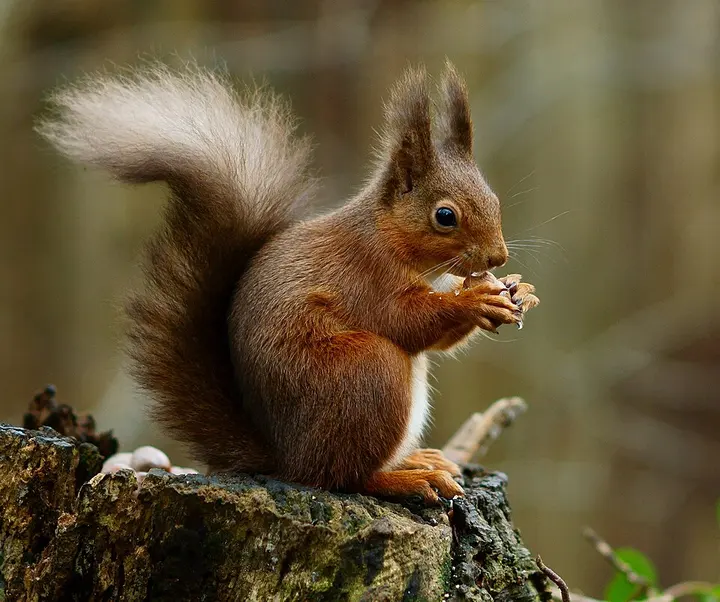
The red squirrel, also called Eurasian red squirrel, is a species of tree squirrel in the genus Sciurus. It is an arboreal and primarily herbivorous rodent and common throughout Eurasia.
Appearance
The red squirrel has a typical head-and-body length of 19 to 23 cm (7.5 to 9.1 in), a tail length of 15 to 20 cm (5.9 to 7.9 in), and a mass of 250 to 340 g (8.8 to 12.0 oz). Males and females are the same size. The long tail helps the squirrel to balance and steer when jumping from tree to tree and running along branches, and may keep the animal warm during sleep. It is also used to signal during social interactions.
Behaviour
The red squirrel is diurnal; activity typically begins at sunrise, but continues after sunset. Between 60% and 80% of its active period may be spent foraging and feeding. Red squirrels do not hibernate. During the winter, however, they may remain within their nest for several days during severe weather. Movement on the ground alternates between series of leaps and alert postures, during which the squirrel sits upright with erect ears while sniffing the air.
Diet
The red squirrel eats mostly the seeds of trees, especially conifers, neatly stripping cones to get at the seeds within, alongside acorns and nuts. Other food sources include fruits and berries, fungi, lichens, young plant shoots, vegetables, garden flowers, and tree sap. More rarely, red squirrels may also eat invertebrates, bird eggs, or nestlings.
Habitat
The red squirrel is found in both coniferous forest and temperate broadleaf woodlands. Red squirrel populations are densest in large areas of coniferous forest, with secondary densities in mixed forests, deciduous forests, and parklands. They can also be found in suburban areas and in conifer plantations. Red squirrels occupy boreal, coniferous woods in northern Europe and Siberia, preferring Scots pine, Norway spruce and Siberian pine.
Life cycle
Mating occurs in late winter during February and March and in summer between June and July. Up to two litters a year per female are possible. Each litter averages three young, called kits. Gestation is about 38 to 39 days. The young are looked after by the mother alone and are born helpless, blind, and deaf. They weigh between 10 and 15g. Hair begins to emerge at 8-9 days of age and covers the body at 21 days.
Where the Red squirrel lives
Recorded in United Kingdom, France, Netherlands, Switzerland, Germany, Norway, Sweden, Finland, Denmark, Russia and Spain (Europe).
Most records fall in Perthshire and Kinross, Nordrhein-Westfalen, Gelderland, Noord-Brabant, Dumfries and Galloway and Aberdeenshire.
See the Red squirrel’s range on the globe
Conservation status
Least concern (LC). Not at risk: it is doing well in the wild. Categories are the IUCN Red List as republished by GBIF.
Sources
The range is a density of 988,786 georeferenced GBIF records, shown on the continents where it is mainly recorded, not an expert-drawn map. Description from Wikipedia.