Animals / Mammal
Red panda
Ailurus fulgens · Ailuridae
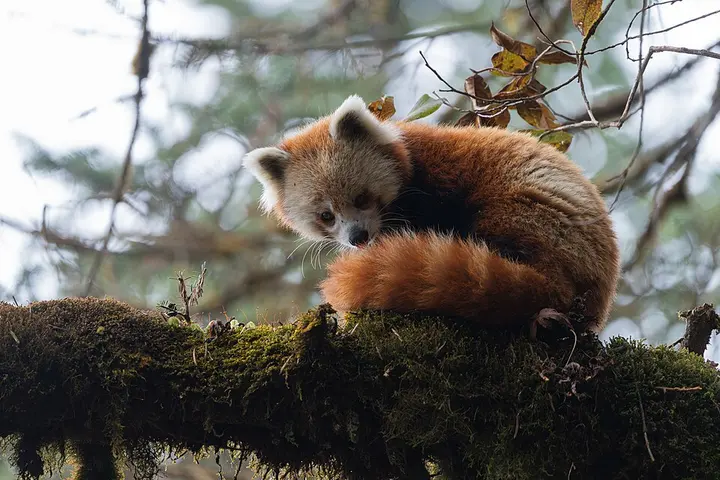
The red panda, also known as the lesser panda, is a small mammal native to the eastern Himalayas and southwestern China. It has dense reddish-brown fur with a black belly and legs, white-lined ears, a mostly white muzzle and a ringed tail. Its head-to-body length is 51–63.5 cm (20.1–25.0 in) with a 28–48.5 cm (11.0–19.1 in) tail, and it weighs between 3.2 and 15 kg.
It is well adapted to climbing due to its flexible joints and curved semi-retractile claws. The red panda was formally described in 1825. The two recognised subspecies, the Himalayan and the Chinese red panda, genetically diverged about 250,000 years ago. The red panda's place on the evolutionary tree has been debated, but modern genetic evidence places it in close affinity with raccoons, weasels, and skunks. It is not closely related to the giant panda, which is a bear, though both possess elongated wrist bones or "false thumbs" used for grasping bamboo. The evolutionary lineage of the red panda (Ailuridae) stretches back around 25 to 18 million years ago, as indicated by extinct fossil relatives found in Eurasia and North America.
Appearance
The red panda's coat is mainly red or orange-brown with a black belly and legs. The muzzle, cheeks, brows and inner ear margins are mostly white while the bushy tail has red and buff ring patterns and a dark brown tip. The colouration appears to serve as camouflage in habitat with red moss and white lichen-covered trees. The guard hairs are longer and rougher while the dense undercoat is fluffier with shorter hairs.
Behaviour
The red panda is difficult to observe in the wild, and most studies on its behaviour have taken place in captivity. The red panda appears to be both nocturnal and crepuscular, sleeping intermittently at night. It typically rests or sleeps in trees or other elevated spaces, stretched out prone on a branch with legs dangling when it is hot, and curled up with its hindlimb over the face when it is cold.
Diet
The red panda is largely herbivorous and feeds primarily on bamboo, mainly the genera Phyllostachys, Sinarundinaria, Thamnocalamus and Chimonobambusa. It also feeds on fruits, blossoms, acorns, eggs, birds and small mammals. Bamboo leaves may be the most abundant food item year-round and the only food they can access during winter.
Habitat
The red panda inhabits Nepal; the states of Sikkim, West Bengal, and Arunachal Pradesh in India; Bhutan; northern Myanmar; and southern Tibet, Sichuan, and Yunnan in China. The global potential habitat of the red panda has been estimated to comprise 47,100 km2 (18,200 sq mi) at most; this habitat is located in the temperate climate zone of the Himalayas with a mean annual temperature range of 18–24 °C (64–75 °F).
Where the Red panda lives
Recorded in India, Nepal, Bhutan and China (Asia).
Most records fall in West Bengal, Mechi, Sikkim, Bagmati, Shemgang and Bumthang.
See the Red panda’s range on the globe
Conservation status
Endangered (EN). In danger of dying out in the wild. Categories are the IUCN Red List as republished by GBIF.
Sources
The range is a density of 95 georeferenced GBIF records, shown on the continents where it is mainly recorded, not an expert-drawn map. Description from Wikipedia.