Animals / Mammal
Red fox
Vulpes vulpes · Canidae
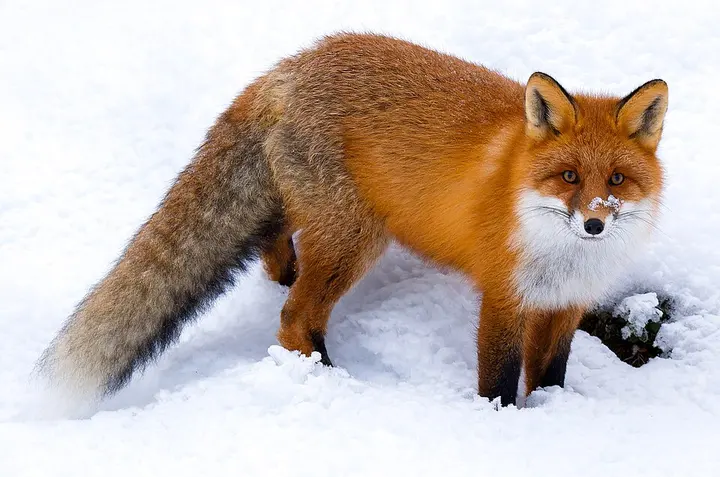
The red fox is the largest of the true foxes, and the most widely distributed member of the order Carnivora. It is present across the entire Northern Hemisphere, including most of North America, Europe and Asia, as well as parts of North Africa. Its range has expanded alongside human settlement, with the species having been introduced to Australia, where it preys on native small and medium-sized rodents and marsupials.
The red fox is listed as of least concern on the IUCN Red List. Because of its impact on native species, it is included on the list of the "world's 100 worst invasive species". The red fox originated in Eurasia during the Middle Pleistocene 400,000 years ago and later colonised North America sometime prior to 130,000 years ago. Apart from its large size, the red fox is distinguished from other fox species by its ability to adapt quickly to new environments. Despite its name, the species often produces individuals with other colourings, including leucistic and melanistic individuals. Forty-five subspecies are currently recognised, which can be divided into two categories: the large northern foxes and the small, basal southern grey desert foxes of Asia and North Africa.
Appearance
The red fox has an elongated body and relatively short limbs. The tail, which is longer than half the body length (70 percent of head and body length), is fluffy and reaches the ground when in a standing position. Their pupils are oval and vertically oriented. Nictitating membranes are present, but move only when the eyes are closed. The forepaws have five digits, while the hind feet have only four and lack dewclaws.
Behaviour
Red foxes either establish stable home ranges within particular areas or are itinerant with no fixed abode. They use their urine to mark their territories. A male fox raises one of his hind legs, spraying his urine forward in front of him. In contrast, a female fox squats down, spraying her urine onto the ground between her hind legs. Urine is also used to mark empty cache sites where found food is stored. This serves as a reminder not to waste time investigating them.
Diet
The red fox is an omnivore with a highly varied diet. It consumes over 300 animal species including small rodents like mice, ground squirrels, hamsters, gerbils, woodchucks, muskrats, voles, pocket gophers, deer mice, leporids, porcupines, raccoons, opossums, birds with passeriformes, galliformes and waterfowl predominating, reptiles, insects and invertebrates. In Doñana National Park, the European rabbit (Oryctolagus cuniculus) is a major prey item.
Habitat
The red fox is the most widespread member of the order Carnivora, and is present on every continent except for South America and Antarctica. Its range covers nearly 70,000,000 km2 (27,000,000 sq mi), extending as far north as the Arctic Circle. It is found throughout Europe, in Africa north of the Sahara Desert, throughout Asia apart from extreme Southeast Asia, and across North America apart from most of the southwestern United States and Mexico.
Where the Red fox lives
Recorded in Switzerland, France, United Kingdom, Netherlands, Spain, Denmark, United States of America, Germany, Sweden and Israel (Europe, Oceania, North America and Asia).
Introduced, not native, in Ashmore and Cartier Is..
Most records fall in Zürich, New South Wales, Vaud, Bern, Sankt Gallen and Solothurn.
See the Red fox’s range on the globe
Conservation status
Least concern (LC). Not at risk: it is doing well in the wild. Categories are the IUCN Red List as republished by GBIF.
Sources
The range is a density of 1,528,557 georeferenced GBIF records, shown on the continents where it is mainly recorded, not an expert-drawn map. Description from Wikipedia.