Animals / Amphibian
Red-eyed tree frog
Agalychnis callidryas · Phyllomedusidae
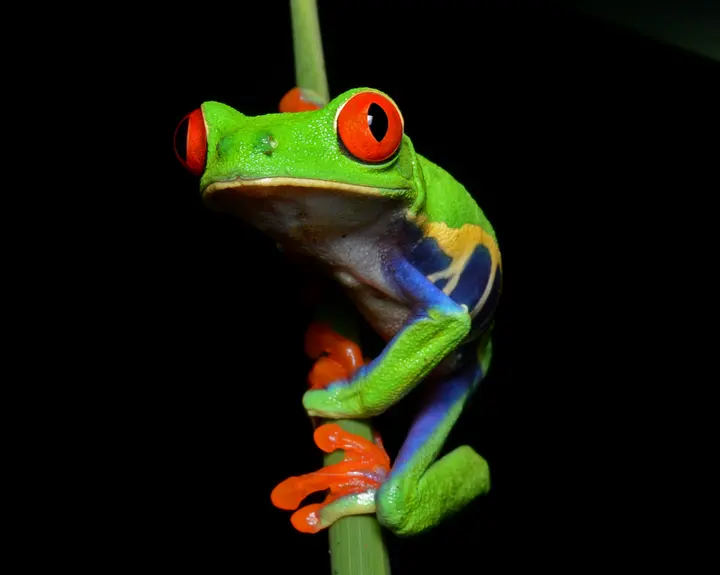
The red-eyed tree frog or red-eyed leaf frog is a species of tree frog in the subfamily Phyllomedusinae native to forests of Central America and northwestern South America. One of the most recognizable frog species, A. callidryas is known for its vibrant coloration, having a bright green body with blue and yellow stripes on the side, a white underside, bright red- to orange-colored feet, and its namesake bright red eyes. Despite these bright colors, the red-eyed tree frog is not poisonous like many other brightly colored amphibians; rather, the colors likely provide camouflage against the greenery of the surrounding jungle, and may also serve to provoke the startle reflex to dissuade predators and allow the frog time to escape.
Like all the species in its genus, A. callidryas is arboreal, possessing long limbs and webbed toes, and is nocturnal, when it mostly hunts for insects. The males of this species are smaller than the females, and they display non-random mating patterns which suggest female choice for specific types of male. They mate and reproduce near ponds, and are therefore found in humid lowlands, especially tropical forests. The embryos of this species are able to respond to approaching predators by hatching early, dropping into the water to escape.
Appearance
Agalychnis callidryas is an easily recognizable species due to its colorful appearance. In terms of size, males reach about 2 in (51 millimetres) while females grow to 3 in (76 millimetres) and are the larger of the two. The adults are distinctively colored, with bright green bodies, light blue or cream-colored bellies, and blue and yellow stripes along their sides.
Behaviour
Adult red-eyed tree frogs are primarily carnivores, eating moths, Orthopterans (crickets, katydids and grasshoppers), Dipterans (flies and mosquitoes), and other insects. Occasionally, they also eat smaller amphibians. Their tadpoles eat plants, algae, plankton, bacteria, carrion, and their fellow tadpoles. After metamorphosis, froglets begin consuming small insects like fruit flies and pinhead crickets.
Habitat
Agalychnis callidryas is native to Central America, ranging from northeastern Honduras to northern Colombia. Its natural habitats include inland forests and wetlands, both tropical and mountainous areas where there is forest cover and water nearby. Ponds or bodies of water are essential for its reproduction so they are invariably found near these areas. The red-eyed tree frog is commonly found in tropical rainforests in the previously listed countries.
Life cycle
Red-eyed tree frogs mate seasonally, specifically in the rainy season during the months of October to March. Males attract females by croaking and wrestle with each other in male-male competition in order to gain access to females for reproduction. Females latch on to the underside of a leaf using the suction cup-like structures on their webbed feet, and the female must hold on to the leaf while males compete and wrestle nearby.
Where the Red-eyed tree frog lives
Recorded in Costa Rica, Panama, Nicaragua, Mexico and Honduras (North America).
Most records fall in Alajuela, Heredia, Limón, Puntarenas, Panama and Guanacaste.
See the Red-eyed tree frog’s range on the globe
Conservation status
Least concern (LC). Not at risk: it is doing well in the wild. Categories are the IUCN Red List as republished by GBIF.
Sources
The range is a density of 8,653 georeferenced GBIF records, shown on the continents where it is mainly recorded, not an expert-drawn map. Description from Wikipedia.