Animals / Bird
Red-crowned crane
Grus japonensis · Gruidae
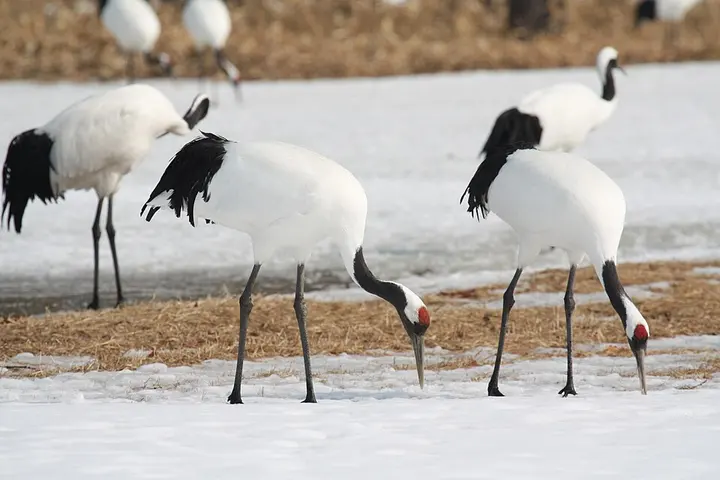
The red-crowned crane, also called the Japanese crane and the Manchurian crane, is a large Northeast Asian crane among the rarest cranes in the world. In some parts of its range, it is known as a symbol of luck, longevity, and fidelity.
Appearance
Adult red-crowned cranes are named for a patch of red bare skin on the crown, which becomes brighter during the mating season. Overall, they are snow white in color with black on the wing secondaries, which can appear almost like a black tail when the birds are standing, but the real tail feathers are actually white. Males are black on the cheeks, throat, and neck, while females are pearly gray in these spots.
Behaviour
Red-crowned cranes have a highly omnivorous diet, though the dietary preferences have not been fully studied. They eat rice, parsley, carrots, corn, redbuds, heath berries, acorns, buckwheat, grasses and a variety of water plants such as reeds. The animal matter in their diet consists of fish, including carp and goldfish, amphibians, especially salamanders, snails, crabs, dragonflies, other insects, small reptiles, shrimp, small birds and rodents.
Diet
Red-crowned cranes have a highly omnivorous diet, though the dietary preferences have not been fully studied. They eat rice, parsley, carrots, corn, redbuds, heath berries, acorns, buckwheat, grasses and a variety of water plants such as reeds. The animal matter in their diet consists of fish, including carp and goldfish, amphibians, especially salamanders, snails, crabs, dragonflies, other insects, small reptiles, shrimp, small birds and rodents.
Life cycle
The red-crowned crane is monogamous and long-lived, with stable pair-bonding both within and between years, and believed to mate for life. The breeding maturity is thought to be reached at 3–4 years of age. All mating and egg-laying are largely restricted to April and early May. A red-crowned crane pair duets in various situations, helping to establish the formation and maintenance of the pair bond, as well as territorial advertisement and agonistic signaling.
Where the Red-crowned crane lives
Recorded in Japan, South Korea, China, Russia and Taiwan (Asia).
Most records fall in Hokkaidō, Gangwon, Amur, Jiangsu, Gyeonggi and New Taipei City.
See the Red-crowned crane’s range on the globe
Conservation status
Vulnerable (VU). At risk: it could become endangered. Categories are the IUCN Red List as republished by GBIF.
Sources
The range is a density of 7,286 georeferenced GBIF records, shown on the continents where it is mainly recorded, not an expert-drawn map. Description from Wikipedia.