Animals / Bird
Rainbow lorikeet
Trichoglossus moluccanus · Psittacidae
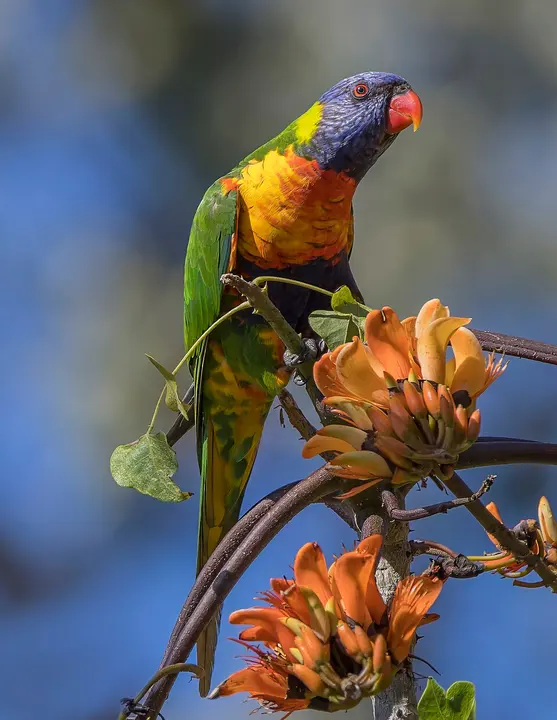
The rainbow lorikeet is a species of parrot found in Australia. It is common along the eastern seaboard, from northern Queensland to South Australia. Its habitat is rainforest, coastal bush, and woodland areas.
Six taxa traditionally listed as subspecies of the rainbow lorikeet are now treated as separate species (see Taxonomy). Rainbow lorikeets have been introduced to Perth, Western Australia; Tasmania; Auckland, New Zealand; and Hong Kong.
Appearance
The rainbow lorikeet is a medium-sized parrot, with the length ranging from 25 to 30 cm (9.8 to 11.8 in), including the tail, and the weight varies from 75 to 157 g (2.6–5.5 oz). The plumage of the nominate race, as with all subspecies, is very bright and colorful. The head is deep blue with a greenish-yellow nuchal collar, and the rest of the upper parts (wings, back, and tail) are green. The chest is orange/yellow. The belly is deep blue, and the thighs and rump are green.
Diet
Rainbow lorikeets feed mainly on fruit, pollen, and nectar and possess a tongue adapted especially for their particular diet. The end of the tongue is equipped with a papillate appendage adapted to gathering pollen and nectar from flowers. Nectar from eucalyptus is important in Australia, other important nectar sources are Pittosporum, Grevillea, Spathodea campanulata (African tulip-tree), and Metroxylon sagu (sago palm).
Life cycle
In southern Australia, breeding usually occurs from late winter to early summer (August to January). Elsewhere in Australia, breeding has been recorded in every month except March, varying from region to region due to changes in food availability and climate. Nesting sites are variable and can include hollows of tall trees such as eucalypts, palm trunks, or overhanging rock. One population in the Admiralty Islands nests in holes in the ground on predator-free islets.
Where the Rainbow lorikeet lives
Recorded in Ashmore and Cartier Is. (Oceania).
Most records fall in New South Wales, Queensland, Victoria, South Australia, Western Australia and Australian Capital Territory.
See the Rainbow lorikeet’s range on the globe
Conservation status
Least concern (LC). Not at risk: it is doing well in the wild. Categories are the IUCN Red List as republished by GBIF.
Sources
The range is a density of 1,631,018 georeferenced GBIF records, shown on the continents where it is mainly recorded, not an expert-drawn map. Description from Wikipedia.