Animals / Mammal
Raccoon
Procyon lotor · Procyonidae
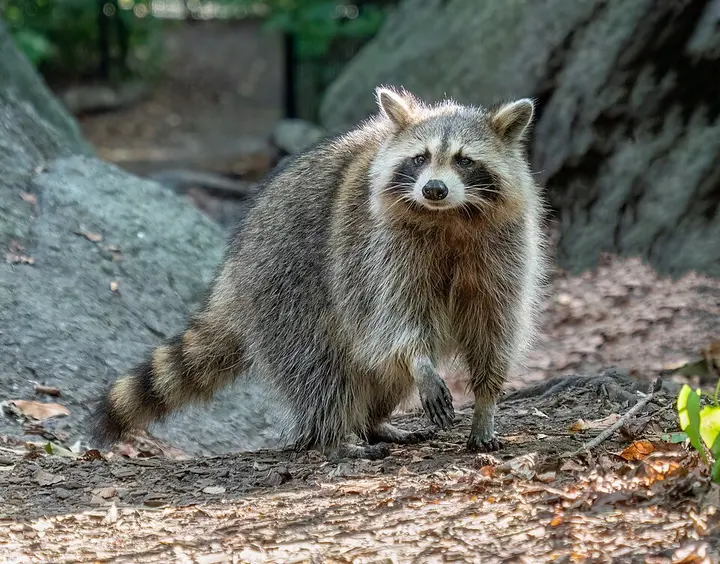
The raccoon, sometimes called the North American, northern or common raccoon to distinguish it from other species of raccoon, is a mammal native to North America. It is the largest of the procyonid family, having a body length of 40 to 70 cm, and a body weight of 5 to 26 kg. Its grayish coat mostly consists of dense underfur, which insulates it against cold weather.
The animal's most distinctive features include its extremely dexterous front paws, its facial mask, and its ringed tail, which are common themes in the mythologies of the Indigenous peoples of the Americas surrounding the species. The raccoon is noted for its intelligence, and studies show that it can remember the solution to tasks for at least three years. It is usually nocturnal and omnivorous, eating about 40% invertebrates, 33% plants, and 27% vertebrates. The original habitats of the raccoon are deciduous and mixed forests. Still, due to their adaptability, they have extended their range to mountainous areas, coastal marshes, and urban areas, where some homeowners consider them to be pests.
Appearance
Head to hindquarters, raccoons measure between 40 and 70 cm (16 and 28 in), not including the bushy tail which can measure between 20 and 40 cm (7.9 and 15.7 in), but is usually not much longer than 25 cm (9.8 in). The shoulder height is between 23 and 30 cm (9.1 and 11.8 in). The body weight of an adult raccoon varies considerably with habitat, making the raccoon one of the most variably sized mammals.
Behaviour
Studies in the 1990s by the ethologists Stanley D. Gehrt and Ulf Hohmann suggest that raccoons engage in sex-specific social behaviors and are not typically solitary, as was previously thought. Related females often live in a so-called "fission-fusion society"; that is, they share a common area and occasionally meet at feeding or resting grounds.
Diet
Though usually nocturnal, the raccoon is sometimes active in daylight to take advantage of available food sources. Its diet consists of about 40% invertebrates, 33% plant material and 27% vertebrates. Since its diet consists of such a variety of different foods, Zeveloff argues the raccoon "may well be one of the world's most omnivorous animals".
Habitat
Although they have thrived in sparsely wooded areas in the last decades, raccoons depend on vertical structures to climb when they feel threatened. Therefore, they avoid open terrain and areas with high concentrations of beech trees, as beech bark is too smooth to climb. Tree hollows in old oaks or other trees and rock crevices are preferred by raccoons as sleeping, winter, and litter dens.
Life cycle
Raccoons usually mate in a period triggered by increasing daylight between late January and mid-March. However, there are large regional differences which are not completely explicable by solar conditions. For example, while raccoons in southern states typically mate later than average, the mating season in Manitoba also peaks later than usual in March and extends until June.
Where the Raccoon lives
Recorded in United States of America, Canada and Mexico (North America and Europe).
Introduced, not native, in Belgium, Germany, Luxembourg and France.
Most records fall in Texas, California, Ontario, Florida, Diekirch and Luxembourg.
See the Raccoon’s range on the globe
Conservation status
Least concern (LC). Not at risk: it is doing well in the wild. Categories are the IUCN Red List as republished by GBIF.
Sources
The range is a density of 193,336 georeferenced GBIF records, shown on the continents where it is mainly recorded, not an expert-drawn map. Description from Wikipedia.