Animals / Mammal
Pygmy hippopotamus
Choeropsis liberiensis · Hippopotamidae
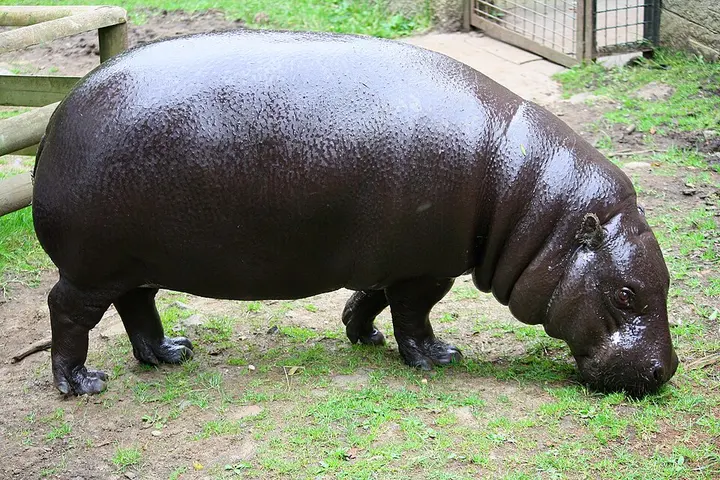
The pygmy hippopotamus or pygmy hippo is a small hippopotamid which is native to the forests and swamps of West Africa, primarily in Liberia, with small populations in Sierra Leone, Guinea, and Ivory Coast. It has been extirpated from Nigeria and possibly Guinea-Bissau.
The pygmy hippopotamus is reclusive and nocturnal. It is one of only two extant species in the family Hippopotamidae, the other being its much larger relative, the common hippopotamus (Hippopotamus amphibius) or Nile hippopotamus. The pygmy hippopotamus displays many terrestrial adaptations, but like the common hippopotamus, it is semiaquatic and relies on water to keep its skin moist and its body temperature cool. Behaviors such as mating and giving birth may occur in water or on land. The pygmy hippopotamus is herbivorous, feeding on ferns, broad-leaved plants, grasses, and fruits it finds in the forests. A rare nocturnal forest creature, the pygmy hippopotamus is a difficult animal to study in the wild. Pygmy hippos were unknown outside West Africa until the 19th century.
Appearance
Pygmy hippopotamuses share the same general form as a hippopotamus. They have a graviportal skeleton, with four stubby legs and four toes on each foot, supporting a portly frame. Yet, the pygmy is only half as tall as the hippopotamus and weighs less than 1/4 as much as its larger cousin. Adult pygmy hippos stand about 75–100 cm (2.46–3.28 ft) high at the shoulder, are 150–175 cm (4.92–5.74 ft) in length and weigh 180–275 kg (397–606 lb).
Behaviour
The behavior of the pygmy hippopotamus differs from the common hippo in many ways. Much of its behavior is more similar to that of a tapir, though this is an effect of convergent evolution. While the common hippopotamus is gregarious, pygmy hippos live either alone or in small groups, typically a mated pair or a mother and calf. Pygmy hippos tend to ignore each other rather than fight when they meet.
Diet
Like the common hippopotamus, the pygmy hippopotamus emerges from the water at dusk to feed. It relies on game trails to travel through dense forest vegetation. It marks trails by vigorously waving its tail while defecating to further spread its feces. The pygmy hippopotamus spends about six hours a day foraging for food. Pygmy hippos are herbivorous.
Life cycle
A study of breeding behavior in the wild has never been conducted; the artificial conditions of captivity may cause the observed behavior of pygmy hippos in zoos to differ from natural conditions. Sexual maturity for the pygmy hippopotamus occurs between three and five years of age. The youngest reported age for giving birth is a pygmy hippopotamus in the Zoo Basel, Switzerland which bore a calf at three years and three months.
Where the Pygmy hippopotamus lives
Recorded in Liberia and Côte d'Ivoire (Africa).
Most records fall in Grand Gedeh, Sinoe, Gbapolu, River Gee, Grand Cape Mount and Bas-Sassandra.
See the Pygmy hippopotamus’s range on the globe
Conservation status
Endangered (EN). In danger of dying out in the wild. Categories are the IUCN Red List as republished by GBIF.
Sources
The range is a density of 335 georeferenced GBIF records, shown on the continents where it is mainly recorded, not an expert-drawn map. Description from Wikipedia.