Animals / Sea urchin
Purple sea urchin
Strongylocentrotus purpuratus · Strongylocentrotidae
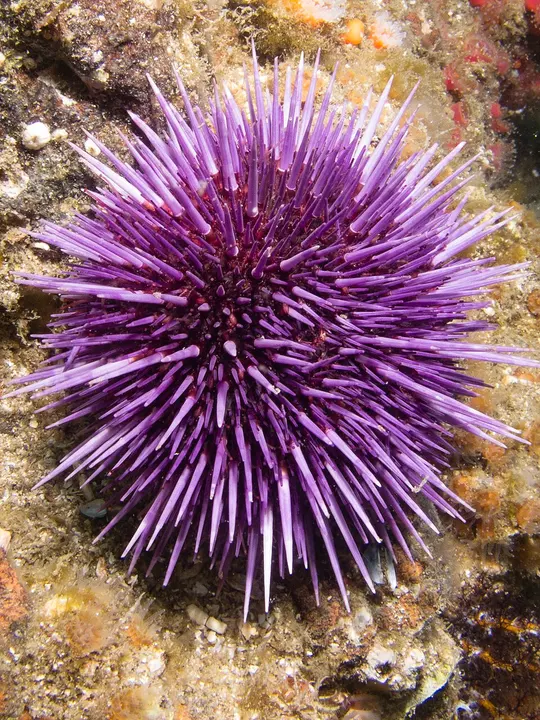
Strongylocentrotus purpuratus is a species of sea urchin in the family Strongylocentrotidae, which is commonly known as the purple sea urchin or Pacific purple sea urchin. It lives along the eastern edge of the Pacific Ocean extending from Ensenada, Mexico, to British Columbia, Canada.
After one of its main predators, the sea otter, experienced a population decline, Strongylocentrotus purpuratus became a threat to the health of kelp forests as its own population boomed. The species is also used as a model organism and its genome was the first echinoderm genome to be sequenced.
Appearance
As the common and specific names suggest, S. purpuratus is deep purple in color. It lives in lower intertidal and nearshore subtidal communities. Purple urchins are broadcast spawners, with females releasing orange eggs and males releasing white sperm into the water column, where fertilization occurs. January, February, and March function as the typical active reproductive months for the species. Sexual maturity is reached around two years.
Behaviour
The purple sea urchin, along with sea otters and abalones, is a prominent member of the kelp forest community. The purple sea urchin also plays a key role in the disappearance of kelp forests that is currently occurring due to climate change; when urchins completely eliminate kelp from an area, it results in an urchin barren. The purple sea urchin cohabits with the red urchin (Mesocentrotus franciscanus) and the two species exhibit niche partitioning.
Where the Purple sea urchin lives
Recorded in United States of America (North America).
Most records fall in California, Washington and Oregon.
See the Purple sea urchin’s range on the globe
Conservation status
Not evaluated (NE). Scientists haven’t checked yet how at risk it is, so this doesn’t mean it is safe or in danger. Categories are the IUCN Red List as republished by GBIF.
Sources
The range is a density of 382,754 georeferenced GBIF records, shown on the continents where it is mainly recorded, not an expert-drawn map. Description from Wikipedia.