Animals / Starfish
Purple sea star
Pisaster ochraceus · Asteriidae
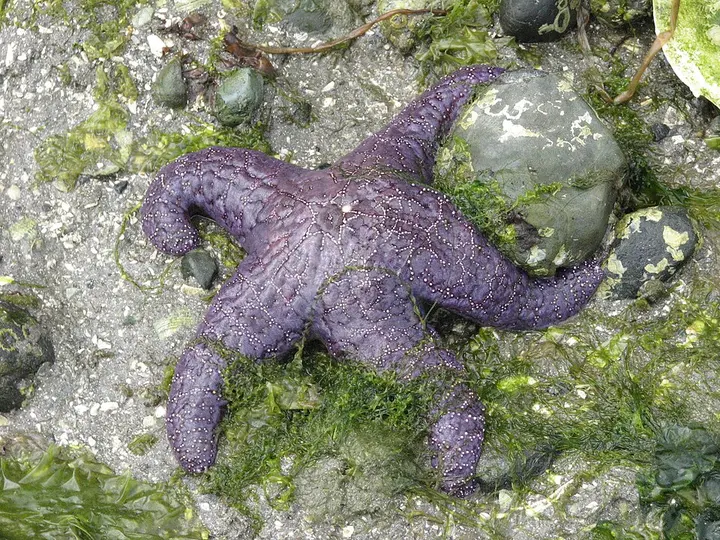
Pisaster ochraceus, generally known as the purple sea star, ochre sea star, or ochre starfish, is a common seastar found among the waters of the Pacific Ocean. Identified as a keystone species, P. ochraceus is considered an important indicator for the health of the intertidal zone.
Appearance
This sea star has five stout rays that range in length from 10 to 25 centimeters (4 to 10 in). The rays are arranged around an ill-defined central disk that needs to be a bit attached to a severed arm to grow a new sea star off of it. While most individuals are purple, they can be orange, orange-ochre, yellow, reddish, or brown. The aboral surface contains many small spines (ossicles) that are arranged in a netlike or pentagonal pattern on the central disk.
Diet
At the larval stage, Pisaster ochraceus are filter feeders and their diet consists of plankton. As an adult, P. ochraceus feeds on mussels such as Mytilus californianus and Mytilus trossulus. They also feed on chitons, limpets, snails, barnacles, echinoids, and even decapod crustacea. P. ochraceus uses its tube feet to handle its prey. If the prey is too large to be swallowed whole, then it can use its tube feet to open shells.
Habitat
Pisaster ochraceus has been described as a keystone species. Experiments by zoologist Robert T. Paine in the 1960s demonstrated that a loss of only a few individual P. ochraceus seastars had a profound impact on mussel bed population, thereby reducing the health of the intertidal environment. With only a few natural predators (sea otters and seagulls) it is suggested that the principal threats to P. ochraceus are human collectors and casual tidepool visitors.
Life cycle
Members of Pisaster are dioecious but there is no sexual dimorphism and sexes can be separated only by the presence of eggs or sperm in the gonads. They reproduce by broadcast spawning, which in the Puget Sound population occurs around May to July. There is no parental investment beyond spawning. Fertilization occurs in the water column and Pisaster ochraceous develops through several larval stages.
Where the Purple sea star lives
Recorded in United States of America and Canada (North America).
Most records fall in California, British Columbia, Washington, Oregon and Alaska.
See the Purple sea star’s range on the globe
Conservation status
Not evaluated (NE). Scientists haven’t checked yet how at risk it is, so this doesn’t mean it is safe or in danger. Categories are the IUCN Red List as republished by GBIF.
Sources
The range is a density of 117,648 georeferenced GBIF records, shown on the continents where it is mainly recorded, not an expert-drawn map. Description from Wikipedia.