Animals / Mammal
Przewalski's horse
Equus przewalskii · Equidae
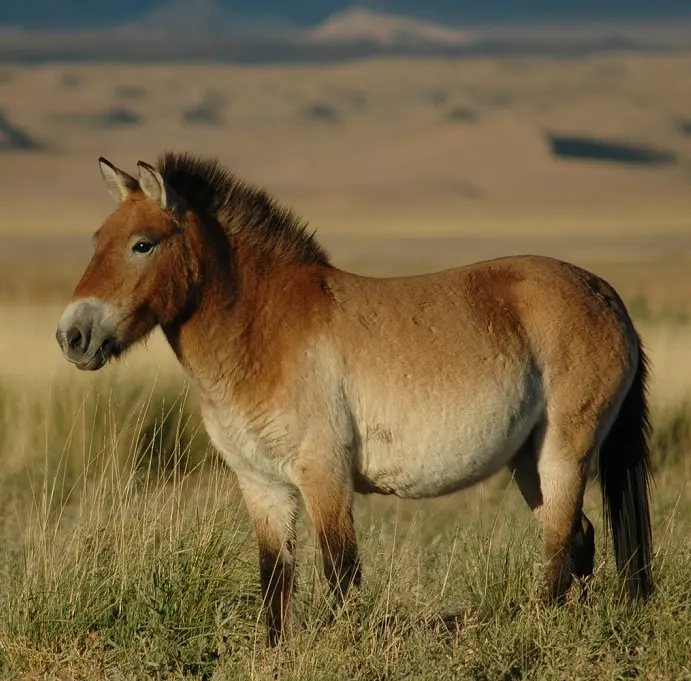
Przewalski's horse, also called the takhi, Mongolian wild horse or Dzungarian horse, is a rare and endangered wild horse originally native to the steppes of Central Asia. It is named after the Russian geographer and explorer Nikolay Przhevalsky. Once extinct in the wild, since the 1990s it has been reintroduced to its native habitat in Mongolia in the Hustai National Park, Takhin Tal Nature Reserve, Khomiin Tal, and several other locales in Central Asia and Eastern Europe.
Several genetic characteristics of Przewalski's horse differ from those seen in modern domestic horses, indicating neither is an ancestor of the other. For example, Przewalski's horse has 33 chromosome pairs compared with 32 for the domestic horse. Their ancestral lineages split from a common ancestor between 160,000 and 38,000 years ago, long before the domestication of the horse. Przewalski's horse was long considered the only remaining truly wild horse, in contrast with the American mustang and the Australian brumby, which are feral horses descended from domesticated animals. That status was called into question when domestic horses of the 5,000-year-old Botai culture of Central Asia were found to be more closely related to Przewalski's horses than to E. f. caballus.
Appearance
Przewalski's horse is stockily built in comparison to domesticated horses, with shorter legs, and is much smaller and shorter than its domesticated relatives. Typical height is about 12–14 hands (48–56 inches, 122–142 cm), and length is about 2.1 m (6 ft 11 in). It weighs around 300 kilograms (660 lb).
Behaviour
Przewalski reported the horses forming troops of between five and fifteen members, consisting of a mature stallion, his mares and foals. Modern reintroduced populations similarly form family groups of one adult stallion, one to three mares, and their common offspring that stay in the family group until they are no longer dependent, usually at two or three years old.
Diet
Przewalski horse's diet consists of vegetation. In the Chernobyl exclusion zone, Przewalski's horses consume primarily grasses and forbs, including Elymus repens, Carex spp., Fabaceae, and Asteraceae. Looking at the species' diet overall, Przewalski's horses most often eat E. repens, Trifolium pratense, Vicia cracca, Poa trivialis, Dactylis glomerata, and Bromus inermis.
Life cycle
Mating occurs in late spring or early summer. Mating stallions do not start looking for mating partners until the age of five. Stallions assemble groups of mares or challenge the leader of another group for dominance. Females are able to give birth at the age of three and have a gestation period of 11–12 months. Foals are able to stand about an hour after birth.
Where the Przewalski's horse lives
Recorded in Ukraine, Mongolia, France, Germany and Austria (Europe and Asia).
Most records fall in Kiev, Töv, Lozère, Bayern, Hessen and Burgenland.
See the Przewalski's horse’s range on the globe
Conservation status
Endangered (EN). In danger of dying out in the wild. Categories are the IUCN Red List as republished by GBIF.
Sources
The range is a density of 851 georeferenced GBIF records, shown on the continents where it is mainly recorded, not an expert-drawn map. Description from Wikipedia.