Animals / Mammal
Pronghorn
Antilocapra americana · Antilocapridae
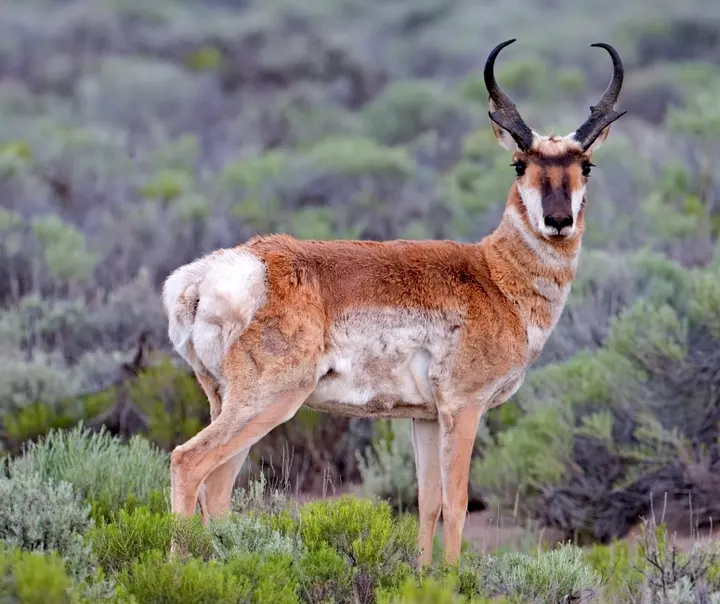
The pronghorn is a species of artiodactyl mammal indigenous to interior western and central North America. Though not an antelope, it is known colloquially in North America as the American antelope, prong buck, pronghorn antelope, and prairie antelope, because it closely resembles the antelopes of the Old World and fills a similar ecological niche due to parallel evolution. It is the only surviving member of the family Antilocapridae.
During the Pleistocene epoch, about 11 other antilocaprid species existed in North America, many with long or spectacularly twisted horns. Three other genera (Capromeryx, Stockoceros and Tetrameryx) existed when humans entered North America, but are now extinct. The pronghorn's closest living relatives are the giraffe and okapi. The antilocaprids are part of the infraorder Pecora, making them distant relatives of deer, bovids, and moschids. The pronghorn is the fastest land mammal in the Americas, with running speeds up to 55 mph (88.5 km/h). It is the symbol of the American Society of Mammalogists.
Appearance
Pronghorns have distinct white fur on their rumps, sides, bellies, breasts, and across their throats. Adult males are 4.3–4.9 ft (1.3–1.5 m) long from nose to tail, stand 2.7–3.4 ft (82–104 cm) high at the shoulder, and weigh 88–143 lb (40–65 kg). The females are the same height as males, but weigh 75–106 lb (34–48 kg). The feet have two hooves, with no dewclaws. Their body temperature is 100 °F (38 °C).
Behaviour
The pronghorn is the fastest land mammal in the Western Hemisphere, being built for maximum predator evasion through running. Their top speed is dependent upon the length of time over which it is measured. It can run 35 mph (56 km/h) for 4 mi (6.5 km), 42 mph (68 km/h) for 1 mi (1.5 km), and 55 mph (88.5 km/h) for 800 metres (0.5 mi). Although it is slower than the African cheetah, it can sustain top speeds much longer than cheetahs.
Where the Pronghorn lives
Recorded in United States of America and Canada (North America).
Most records fall in Wyoming, Colorado, Utah, New Mexico, South Dakota and Montana.
See the Pronghorn’s range on the globe
Conservation status
Least concern (LC). Not at risk: it is doing well in the wild. Categories are the IUCN Red List as republished by GBIF.
Sources
The range is a density of 21,206 georeferenced GBIF records, shown on the continents where it is mainly recorded, not an expert-drawn map. Description from Wikipedia.