Animals / Mammal
Proboscis monkey
Nasalis larvatus · Cercopithecidae
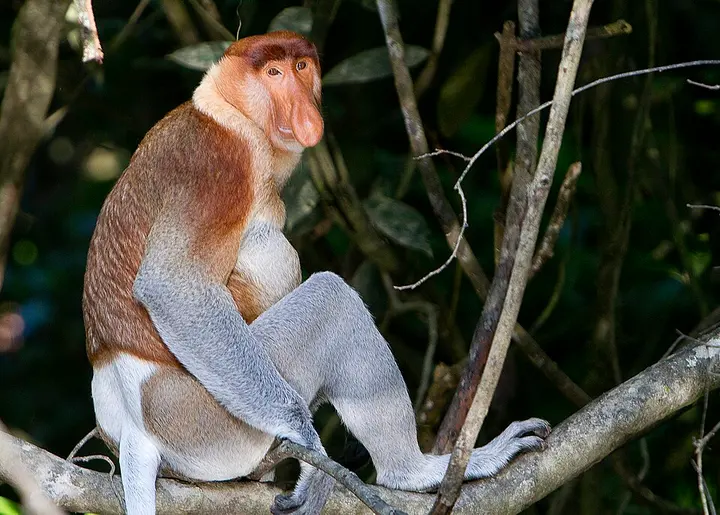
The proboscis monkey or long-nosed monkey is an arboreal Old World monkey with an unusually large nose, a reddish-brown skin color and a long tail. It is endemic to the Southeast Asian island of Borneo and is found mostly in mangrove forests and on the coastal areas of the island.
This species co-exists with the Bornean orangutan and monkeys such as the silvery lutung. It belongs in the monotypic genus Nasalis.
Appearance
The proboscis monkey is a large species, being one of the largest monkey species native to Asia. Only the Tibetan macaque and a few of the gray langurs can rival its size. Sexual dimorphism is pronounced in the species. Males have a head-body length of 66 to 76.2 cm (26.0 to 30.0 in) and typically weigh 16 to 22.5 kg (35 to 50 lb), with a maximum known weight of 30 kg (66 lb).
Behaviour
Proboscis monkeys generally live in groups composed of one adult male, some adult females and their offspring. All-male groups may also exist. Some individuals are solitary, mostly males. Monkey groups live in overlapping home ranges, with little territoriality, in a fission-fusion society, with groups gathering at sleeping sites as night falls. There exist bands which arise when groups come together and slip apart yet sometimes groups may join to mate and groom.
Habitat
The proboscis monkey is endemic to the island of Borneo and can be found in all three nations that divide the island: Brunei, Indonesia and Malaysia. It is most common in coastal areas and along rivers. This species is restricted to lowland habitats that may experience tides. It favors dipterocarp, mangrove and riverine forests.
Life cycle
Females become sexually mature at the age of five years. They experience sexual swelling, which involves the genitals becoming pink or reddened. At one site, matings largely take place between February and November, while births occur between March and May. Copulations tend to last for half a minute. The male will grab the female by the ankles or torso and mount her from behind. Both sexes will encourage mating, but they are not always successful.
Where the Proboscis monkey lives
Recorded in Malaysia, Indonesia and Brunei (Asia).
Most records fall in Sabah, Sarawak, Kalimantan Tengah, Brunei and Muara, Kalimantan Timur and Kalimantan Selatan.
See the Proboscis monkey’s range on the globe
Conservation status
Endangered (EN). In danger of dying out in the wild. Categories are the IUCN Red List as republished by GBIF.
Sources
The range is a density of 2,544 georeferenced GBIF records, shown on the continents where it is mainly recorded, not an expert-drawn map. Description from Wikipedia.