Animals / Jellyfish
Portuguese man o' war
Physalia physalis · Physaliidae
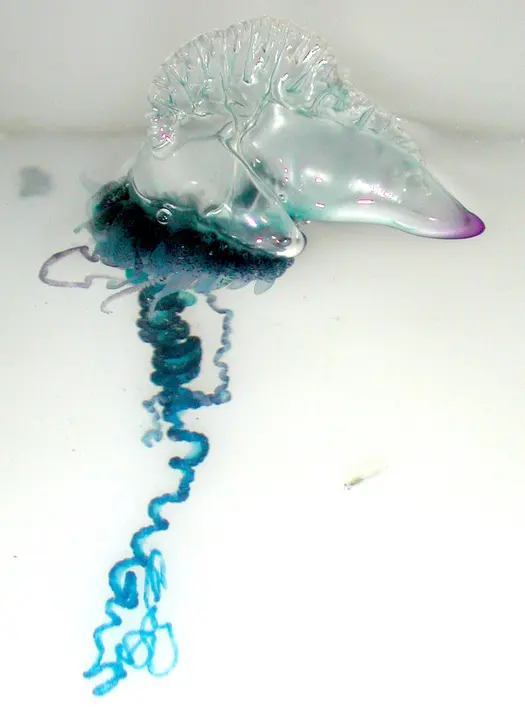
The Portuguese man o' war, also known as the man-of-war, bluebottle, or sometimes called Caravela Portuguesa, is a marine hydrozoan found in the Atlantic, Indian, and Pacific oceans. While it is typically considered the only species in its genus, Physalia, and family, Physaliidae, genetic evidence suggests there may be more.
Although it superficially resembles a jellyfish, the Portuguese man o' war is in fact a siphonophore. Like all siphonophores, it is a colonial organism, made up of many smaller units called zooids. Although they are morphologically quite different, all of the zooids in a single specimen are genetically identical. These different types of zooids fulfill specialized functions, such as hunting, digestion, and reproduction, and together they allow the colony to operate as a single individual. The man o' war is part of the neuston, organisms that live on the surface of the water.
Appearance
Like all siphonophores, the man o' war is a colonial organism: each animal is composed of many smaller units (zooids) that hang in clusters from under a large, gas-filled structure called the pneumatophore. The individual zooids in a colony are evolutionarily derived from either polyps or medusae, i.e. the two basic body plans of cnidarians.
Behaviour
The Portuguese man o' war is a member of the neuston, organisms that live on the surface of bodies of water. This community is exposed to a unique set of environmental conditions including prolonged exposure to intense ultraviolet light, risk of desiccation, and rough sea conditions. The gas-filled bladder, or pneumatophore, remains at the surface, while the remainder is submerged.
Habitat
The Portuguese man o' war is a member of the neuston, organisms that live on the surface of bodies of water. This community is exposed to a unique set of environmental conditions including prolonged exposure to intense ultraviolet light, risk of desiccation, and rough sea conditions. The gas-filled bladder, or pneumatophore, remains at the surface, while the remainder is submerged.
Life cycle
Man o' war individuals are dioecious, meaning each colony is either male or female. Gonophores producing either sperm or eggs (depending on the sex of the colony) sit on a tree-like structure called a gonodendron, which is believed to drop off from the colony during reproduction. The eggs and sperm are released from gonophores directly into the water.
Where the Portuguese man o' war lives
Recorded in United States of America, Ashmore and Cartier Is., Portugal, Spain, New Zealand, South Africa, Mexico, Ireland, Brazil, United Kingdom and Ecuador (North America, Oceania, Europe, Africa and South America).
Most records fall in Florida, New South Wales, Texas, Hawaii, Western Cape and Azores.
See the Portuguese man o' war’s range on the globe
Conservation status
Not evaluated (NE). Scientists haven’t checked yet how at risk it is, so this doesn’t mean it is safe or in danger. Categories are the IUCN Red List as republished by GBIF.
Sources
The range is a density of 16,873 georeferenced GBIF records, shown on the continents where it is mainly recorded, not an expert-drawn map. Description from Wikipedia.