Animals / Mammal
Polar bear
Ursus maritimus · Ursidae
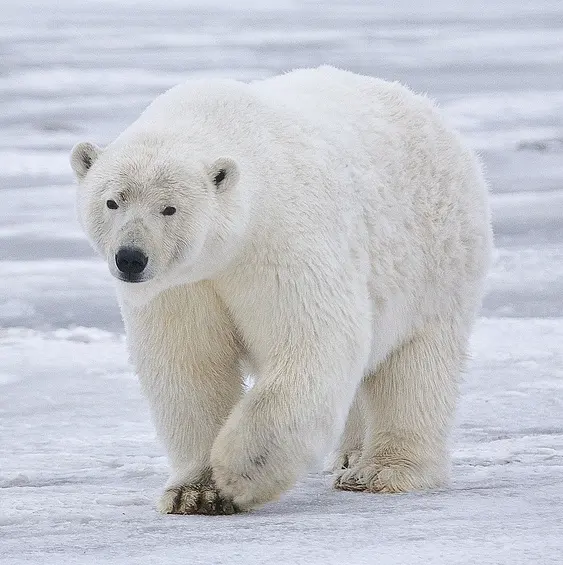
The polar bear is a large bear native to the Arctic and nearby areas. It is closely related to the brown bear, and the two species can interbreed. The polar bear is the largest extant species of bear and land carnivore by body mass, with adult males weighing 300–800 kg (660–1,760 lb).
The species is sexually dimorphic, as adult females are much smaller. The polar bear is white or yellowish-furred with black skin and a thick layer of fat. It is more slender than the brown bear, with a narrower skull, longer neck and lower shoulder hump. Its teeth are sharper and more adapted to cutting meat. The paws are large and allow the bear to walk on ice and paddle in the water. Polar bears are both terrestrial and pagophilic (ice-living) and are considered marine mammals because of their dependence on marine ecosystems. They prefer the annual sea ice but live on land when the ice melts in the summer. They are mostly carnivorous and specialized for preying on seals, particularly ringed seals.
Appearance
The polar bear is the largest living species of bear and land carnivore, though some brown bear subspecies like the Kodiak bear can rival it in size. Males are generally 200–250 cm (6.6–8.2 ft) long with a weight of 300–800 kg (660–1,760 lb). Females are smaller at 180–200 cm (5.9–6.6 ft) with a weight of 150–300 kg (330–660 lb). Sexual dimorphism in the species is particularly high compared with most other mammals.
Behaviour
Polar bears may travel areas as small as 3,500 km2 (1,400 sq mi) to as large as 38,000 km2 (15,000 sq mi) in a year, while drifting ice allows them to move further. Depending on ice conditions, a bear can travel an average of 12 km (7.5 mi) per day. These movements are powered by their energy-rich diet. Polar bears move by walking and galloping and do not trot. Walking bears tilt their front paws towards each other.
Diet
The polar bear is a hypercarnivore, and the most carnivorous species of bear. It is an apex predator of the Arctic, preying on ice-living seals and consuming their energy-rich blubber. The most commonly taken species is the ringed seal, but they also prey on bearded seals and harp seals. Ringed seals are ideal prey as they are abundant and small enough to be overpowered by even small bears.
Habitat
Polar bears inhabit the Arctic and adjacent areas. Their range includes Greenland, Canada, Alaska, Russia and the Svalbard Archipelago of Norway. Polar bears have been recorded as close as 25 km (16 mi) from the North Pole. The southern limits of their range include James Bay and Newfoundland and Labrador in Canada and St. Matthew Island and the Pribilof Islands of Alaska.
Where the Polar bear lives
Recorded in Canada, United States of America, Greenland and Russia (North America and Asia).
Most records fall in Alaska, Nunavut, Manitoba, Chukchi Autonomous Okrug, Kommuneqarfik Sermersooq and Northwest Territories.
See the Polar bear’s range on the globe
Conservation status
Vulnerable (VU). At risk: it could become endangered. Categories are the IUCN Red List as republished by GBIF.
Sources
The range is a density of 5,902 georeferenced GBIF records, shown on the continents where it is mainly recorded, not an expert-drawn map. Description from Wikipedia.