Animals / Mammal
Platypus
Ornithorhynchus anatinus · Ornithorhynchidae
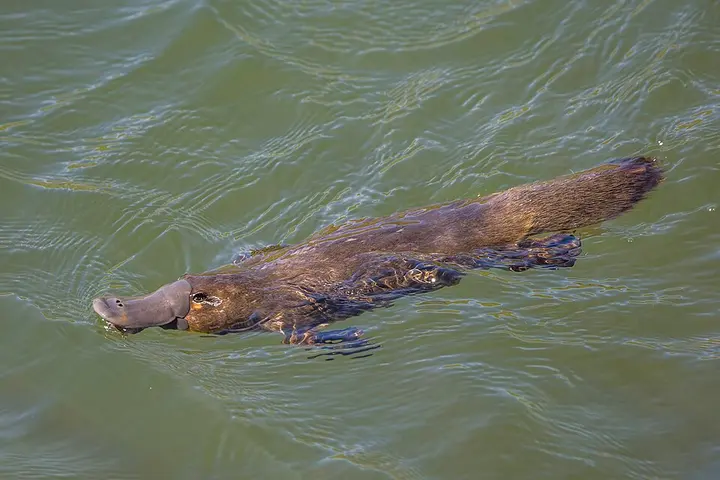
The platypus, sometimes referred to as the duck-billed platypus, is a semiaquatic, egg-laying mammal endemic to eastern Australia, including Tasmania. The platypus is the sole living representative of the family Ornithorhynchidae and genus Ornithorhynchus, though a number of related species appear in the fossil record. Together with the four species of echidna, it is one of the five extant species of monotremes, mammals that lay eggs instead of giving birth to live young.
Like other monotremes, the platypus has a sense of electrolocation, which it uses to detect prey in water while its eyes, ears and nostrils are closed. It is one of the few species of venomous mammals, as the male platypus has a spur on each hind foot that delivers an extremely painful venom. The unusual appearance of this egg-laying, duck-billed, beaver-tailed mammal at first baffled European naturalists. In 1799, the first scientists to examine a preserved platypus body judged it a fake made of several animals sewn together. The unique features of the platypus make it important in the study of evolutionary biology, and a recognisable and iconic symbol of Australia.
Appearance
Most of the platypus' small streamlined body is covered with short, dense, brown fur that traps a layer of insulating air to keep the animal warm, both in and out of water. The fur coat is waterproof and consists of flattened guard hairs and curvy underfur hairs. It is one of the most densely furred mammals, behind only otters.
Behaviour
The platypus is semiaquatic and requires permanent freshwater habitat. Its swimming style is unique among mammals, propelling itself by alternating strokes of each front foot, while the webbed hind feet and tail are used for steering. It can maintain its relatively low body temperature when feeding in colder depths of below 5 °C (41 °F). In one study, dives lasted on average thirty-five seconds, with surfacing intervals averaging thirteen seconds.
Habitat
The platypus is native to the freshwaters of eastern Australia, from Queensland to Tasmania (including King Island but not the Furneaux Group). It was believed to be extinct on the South Australian mainland, with the last sighting recorded at Renmark in 1975. Platypuses were captively bred at Warrawong Sanctuary in 1990-91. In October 2020 a nesting platypus was filmed in the wild after the previously abandoned Sanctuary reopened.
Life cycle
Platypuses are seasonal breeders, with the more southerly populations breeding later in the year than those further north; those in New South Wales mate during fall and winter. Research has found both resident and transient platypuses, and suggest a polygynous mating system. Females are believed to become sexually mature at two years of age and continue to breed beyond nine years.
Where the Platypus lives
Recorded in Ashmore and Cartier Is. (Oceania).
Most records fall in New South Wales, Victoria, Queensland, Tasmania, Australian Capital Territory and South Australia.
See the Platypus’s range on the globe
Conservation status
Near threatened (NT). Not at risk yet, but could be soon. Categories are the IUCN Red List as republished by GBIF.
Sources
The range is a density of 25,120 georeferenced GBIF records, shown on the continents where it is mainly recorded, not an expert-drawn map. Description from Wikipedia.