Animals / Bird
Peregrine falcon
Falco peregrinus · Falconidae
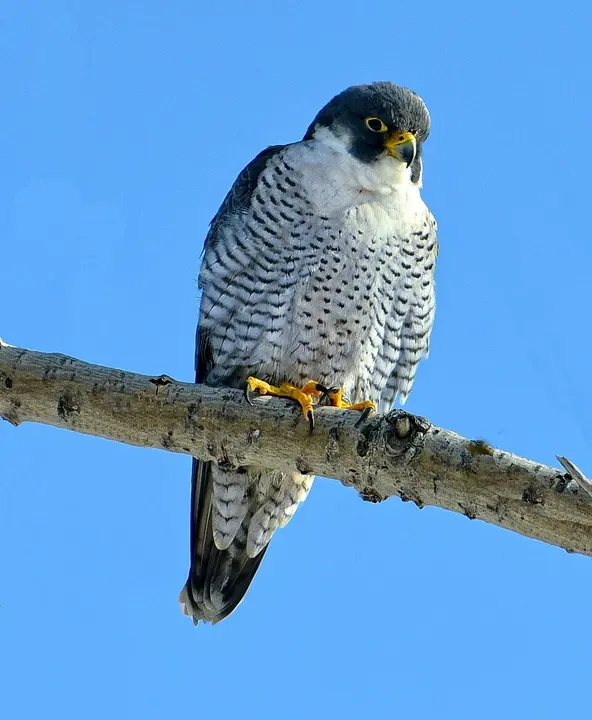
The peregrine falcon, sometimes referred to simply as the peregrine, is a bird of prey (raptor) in the family Falconidae known for its speed. A large, crow-sized falcon, it has a blue-grey back, barred white underparts and a black head. As is typical for bird-eating (avivore) raptors, peregrine falcons are sexually dimorphic, with females being considerably larger than males.
Historically, the bird has also been known as the "black-cheeked falcon" in Australia and the "duck hawk" in North America. The breeding range includes land regions from the Arctic tundra to the tropics. It can be found nearly everywhere on Earth, except extreme polar regions, very high mountains, and most tropical rainforests. The only major ice-free landmasses from which it is entirely absent are the islands of New Zealand, making it the world's most widespread raptor and one of the most widely found wild bird species. In fact, the only land-based bird species found over a larger geographic area, domestic and feral pigeons, owe their success to human-led introduction. Both are domesticated forms of the rock dove, and are a major prey species for peregrine populations.
Appearance
The peregrine falcon has a body length of 34 to 58 cm (13–23 in) and a wingspan from 74 to 120 cm (29–47 in). The male and female have similar markings and plumage but, as with many birds of prey, the peregrine falcon displays marked sexual dimorphism in size, with the female measuring up to 30% larger than the male. Males weigh 330 to 1,000 g (12–35 oz) and the noticeably larger females weigh 700 to 1,500 g (25–53 oz).
Behaviour
The peregrine falcon lives mostly along mountain ranges, river valleys, coastlines, and increasingly in cities. In mild-winter regions, it is usually a permanent resident, and some individuals, especially adult males, will remain on the breeding territory. Only populations that breed in Arctic climates typically migrate great distances during the northern winter.
Diet
The peregrine falcon's diet varies greatly and is adapted to available prey in different regions. However, it typically feeds on medium-sized birds such as pigeons and doves, waterfowl, gamebirds, songbirds, parrots, seabirds, and waders. Worldwide, it is estimated that between 1,500 and 2,000 bird species, or roughly a fifth of the world's bird species, are predated somewhere by these falcons.
Life cycle
The peregrine falcon is sexually mature at one to three years of age, but in larger populations they breed after two to three years of age. A pair mates for life and returns to the same nesting spot annually. The courtship flight includes a mix of aerial acrobatics, precise spirals, and steep dives. The male passes prey it has caught to the female in mid-air. To make this possible, the female flies upside-down to receive the food from the male's talons.
Where the Peregrine falcon lives
Recorded in United States of America, Sweden, Netherlands, Canada, Denmark, France, United Kingdom, Spain, Norway, Ashmore and Cartier Is. and Belgium (North America, Europe and Oceania).
Most records fall in California, New Jersey, New York, Québec, Massachusetts and Texas.
See the Peregrine falcon’s range on the globe
Conservation status
Least concern (LC). Not at risk: it is doing well in the wild. Categories are the IUCN Red List as republished by GBIF.
Sources
The range is a density of 2,841,143 georeferenced GBIF records, shown on the continents where it is mainly recorded, not an expert-drawn map. Description from Wikipedia.