Animals / Reptile
Painted turtle
Chrysemys picta · Emydidae
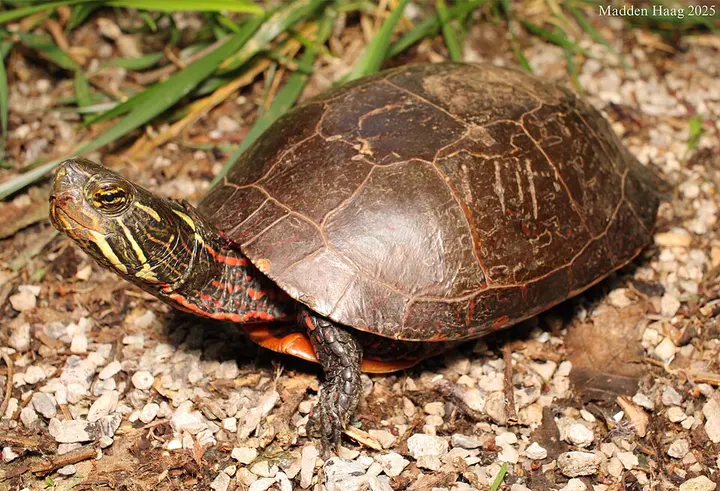
The painted turtle is North America's most widespread native turtle, with a rich evolutionary history that stretches back 15 million years. As resilient survivors belonging to the pond turtle family Emydidae, these turtles adapted creatively to the planet's changing climate. During the last Ice Age, they split into distinct groups and evolved into three regionally unique subspecies: the Eastern painted turtle, the Midland painted turtle, and the Western painted turtle.
Scientists still debate whether a fourth group, the Southern painted turtle, is its own separate species or another subspecies. Because they are highly adaptable and widely distributed across fresh waters from Canada to Mexico, their conservation status is listed as Least Concern, meaning they are currently thriving in the wild. It lives in relatively slow-moving fresh waters, from southern Canada to northern Mexico, and from the Atlantic to the Pacific. They have been shown to prefer large wetlands with long periods of inundation and emergent vegetation. The adult painted turtle is 13–25 cm (5.1–9.8 in) long; the male is smaller than the female. The turtle's top shell is dark and smooth, without a ridge. Its skin is olive to black with red, orange, or yellow stripes on its extremities.
Appearance
Adult painted turtles can grow to 13–25 cm (5–10 in) long, with males being smaller. The shell is oval, smooth with little grooves where the large scale-like plates overlap, and flat-bottomed. The color of the top shell (carapace) varies from olive to black. Darker specimens are more common where the bottom of the water body is darker. The bottom shell (plastron) is yellow, sometimes red, sometimes with dark markings in the center.
Behaviour
The painted turtle is a bottom-dwelling hunter. It quickly juts its head into and out of vegetation to stir potential victims out into the open water, where they are pursued. Large prey is ripped apart with the forefeet as the turtle holds it in its mouth. It also consumes plants and skims the surface of the water with its mouth open to catch small particles of food.
Diet
The painted turtle is a bottom-dwelling hunter. It quickly juts its head into and out of vegetation to stir potential victims out into the open water, where they are pursued. Large prey is ripped apart with the forefeet as the turtle holds it in its mouth. It also consumes plants and skims the surface of the water with its mouth open to catch small particles of food.
Habitat
The most widespread North American turtle, the painted turtle is the only turtle whose native range extends from the Atlantic to the Pacific. It is native to eight of Canada's ten provinces, forty-five of the fifty United States, and one of Mexico's thirty-one states. On the East Coast, it lives from the Canadian Maritimes to the U.S. state of Georgia. On the West Coast, it lives in British Columbia, Washington, and Oregon and offshore on southeast Vancouver Island.
Where the Painted turtle lives
Recorded in United States of America and Canada (North America).
Most records fall in Ontario, Virginia, Ohio, Massachusetts, Michigan and Québec.
See the Painted turtle’s range on the globe
Conservation status
Least concern (LC). Not at risk: it is doing well in the wild. Categories are the IUCN Red List as republished by GBIF.
Sources
The range is a density of 142,403 georeferenced GBIF records, shown on the continents where it is mainly recorded, not an expert-drawn map. Description from Wikipedia.