Animals / Insect
Painted lady
Vanessa cardui · Nymphalidae
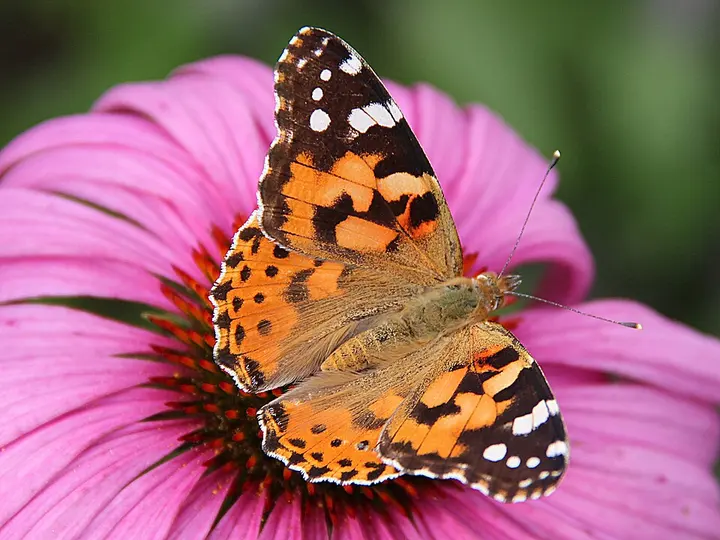
Vanessa cardui is the most widespread of all butterfly species. It is commonly called the painted lady, or formerly in North America the cosmopolitan butterfly.
Appearance
Male and female. Upperside.
Behaviour
Larvae feed on Asteraceae species, including Cirsium, Carduus, Centaurea, Arctium, Onopordum, Helianthus and Artemisia. The painted lady uses more than 300 recorded host plants according to the HOSTS database. Adult butterflies feed on flower nectar and aphid honeydew.
Habitat
V. cardui is one of the most widespread of all butterflies, found on every continent except Antarctica. It is rare or vagrant in South America. In Australia V. cardui has a limited range around Bunbury, Fremantle and Rottnest Island. However its close relative, the Australian painted lady (V. kershawi, sometimes considered a subspecies), ranges over half the continent.
Life cycle
V. cardui displays a unique system of continuous mating, throughout all seasons, including the winter. This may be attributed to its migratory patterns, thus significantly affecting its mating behaviour. During European migrations, the butterflies immediately begin to mate and lay eggs upon arrival in the Mediterranean in the spring, starting in late May.
Where the Painted lady lives
Recorded in United Kingdom, Netherlands, France, Switzerland, United States of America, Belgium, Germany, Sweden, Spain and Denmark (Europe and North America).
Most records fall in Zuid-Holland, Noord-Brabant, Noord-Holland, Dorset, Hampshire and Gelderland.
See the Painted lady’s range on the globe
Conservation status
Least concern (LC). Not at risk: it is doing well in the wild. Categories are the IUCN Red List as republished by GBIF.
Sources
The range is a density of 1,577,290 georeferenced GBIF records, shown on the continents where it is mainly recorded, not an expert-drawn map. Description from Wikipedia.