Animals / Amphibian
Pacific tree frog
Pseudacris regilla · Hylidae
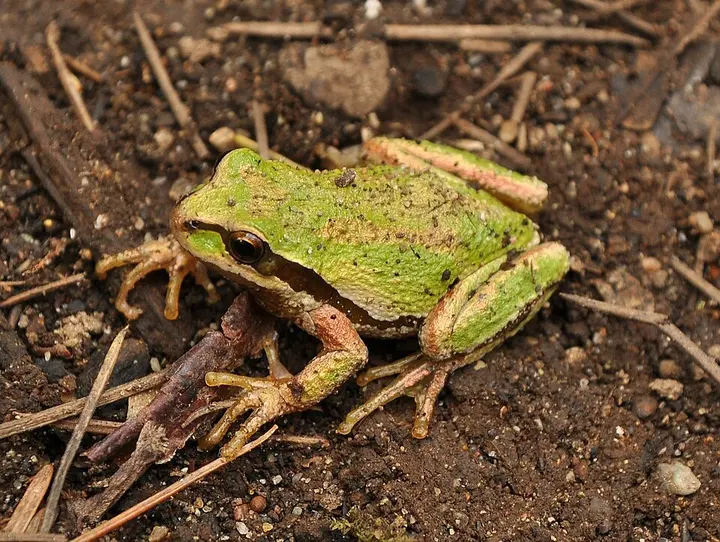
The Pacific tree frog, also known as the Pacific chorus frog, has a range spanning the Pacific Northwest, from Northern California, Oregon, and Washington to British Columbia in Canada and extreme southern Alaska. They live from sea level to more than 10,000 feet in many types of habitats, reproducing in aquatic settings. They occur in shades of greens or browns and can change colors over periods of hours and weeks.
Appearance
The Pacific tree frog grows up to two inches from snout to urostyle. The males are usually smaller than the females and have a dark patch on their throats. The dark patch is the vocal sac, which stretches out when the male is calling. Pacific tree frogs can be a number of different colors, including green, tan, reddish, gray, brown, cream, and black, but most are a shade of green or brown, with pale or white bellies.
Where the Pacific tree frog lives
Recorded in United States of America, Canada and Mexico (North America).
Most records fall in California, Oregon, Washington, British Columbia, Baja California and Nevada.
See the Pacific tree frog’s range on the globe
Conservation status
Least concern (LC). Not at risk: it is doing well in the wild. Categories are the IUCN Red List as republished by GBIF.
Sources
The range is a density of 85,022 georeferenced GBIF records, shown on the continents where it is mainly recorded, not an expert-drawn map. Description from Wikipedia.