Animals / Jellyfish
Pacific sea nettle
Chrysaora fuscescens · Pelagiidae
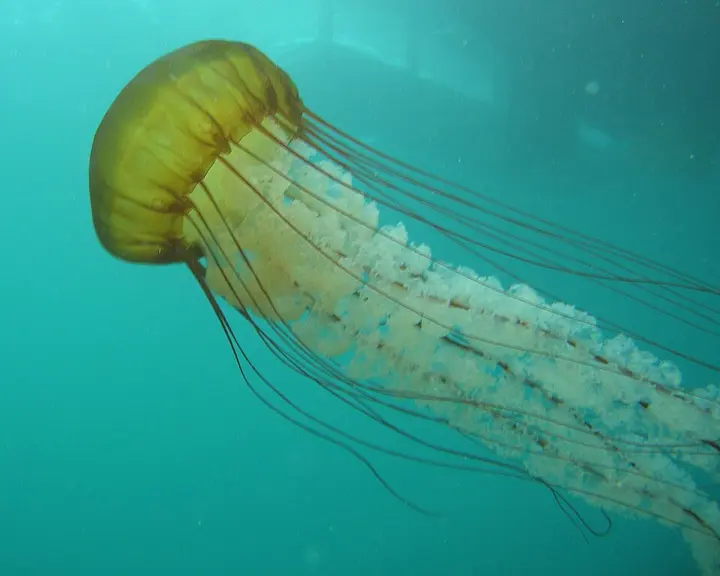
Chrysaora fuscescens, the Pacific sea nettle or West Coast sea nettle, is a widespread jellyfish that lives in the northeastern Pacific Ocean, in temperate to cooler waters off of British Columbia and the West Coast of the United States, ranging south to Mexico. The Pacific sea nettle earned its common name in-reference to its defensive, 'nettle'-like sting; much like the stinging nettle plant, the sea nettle's defensive sting is often irritating to humans, though rarely dangerous.
The Pacific sea nettle has a distinctive, golden-brown bell with a reddish tint. The bell can grow to be larger than one meter (3’) in diameter in the wild; however, most are less than 50 cm across. The long and spiraling, whitish oral arms (and 24 undulating, maroon tentacles) may trail behind the nettle as far as 15 feet (4.6 m). Since about the mid-20th century, C. fuscescens has proven to be a very popular cnidarian to feature at aquariums (and even some zoos with aquatic exhibits), mainly due to the public's fascination with their bright colors and extremely long tentacles. Additionally, the species is known for being quite low-maintenance in captivity, when provided with the appropriate water parameters and conditions.
Appearance
Chrysaora fuscescens swim using jet propulsion by squeezing their bell and pushing water behind them, allowing them to swim against currents, although most of the time they simply float. Occasionally, they pick up hitchhikers, including small fish and crabs, which hide inside the sea nettle's bell and may feed on it. The Chrysaora fuscescens use light sensing organs called ocelli to migrate from the deeper waters of the ocean to the surface.
Habitat
Chrysaora fuscescens is commonly found along the coasts of southern British Columbia, Washington, Oregon and most of California to Baja California Sur, Mexico. Some sea nettles will range further north to the Gulf of Alaska, or west to Japan, and rarely into the Gulf of California. The populations reach their peak during the late summer. In recent years, C. fuscescens has become overly abundant off the coast of Oregon, which is thought to be an indicator of climate change.
Life cycle
Chrysaora fuscescens is capable of both sexual reproduction in the medusa stage and asexual reproduction in the polyp stage. The life cycle of C. fuscescens begins when females catch sperm released by the males to fertilize the eggs she has produced and is holding in her mouth. These fertilized eggs remain attached to her oral arms, and there they grow into flat bean-shaped planula, the free-swimming larval stage of cnidarians.
Where the Pacific sea nettle lives
Recorded in United States of America and Canada (North America).
Most records fall in California, Oregon, Washington and British Columbia.
See the Pacific sea nettle’s range on the globe
Conservation status
Not evaluated (NE). Scientists haven’t checked yet how at risk it is, so this doesn’t mean it is safe or in danger. Categories are the IUCN Red List as republished by GBIF.
Sources
The range is a density of 3,248 georeferenced GBIF records, shown on the continents where it is mainly recorded, not an expert-drawn map. Description from Wikipedia.