Animals / Bird
Osprey
Pandion haliaetus · Pandionidae
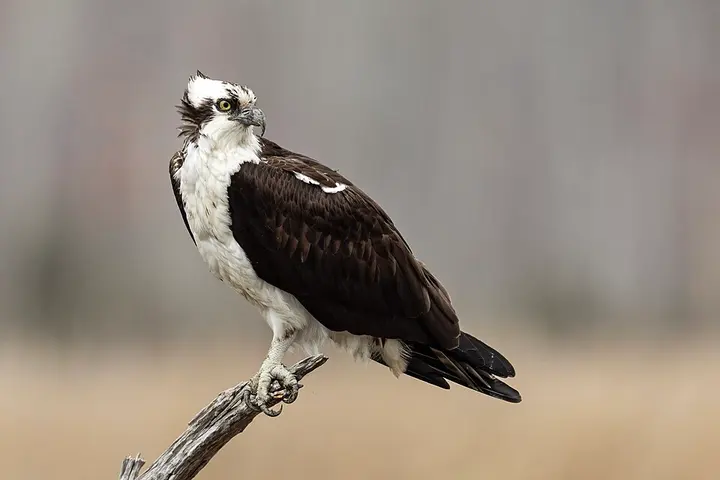
The osprey, historically known as sea hawk, river hawk, and fish hawk, is a diurnal, fish-eating bird of prey with a cosmopolitan range. It is a large raptor, reaching more than 60 cm (24 in) in length and a wingspan of 180 cm (71 in). It is brown on the upperparts and predominantly greyish on the head and underparts.
The osprey is distributed on all continents except Antarctica, but in South America, it occurs only as a nonbreeding migrant. It lives in a wide variety of habitats and nests in locations near a body of water providing an adequate food supply. It has specialised physical characteristics and unique behaviour in hunting its prey, which consists almost exclusively of fish.
Appearance
The osprey differs in several respects from other diurnal birds of prey. Its toes are of equal length, its tarsi are reticulated, and its talons are rounded, rather than grooved. The osprey and owls are the only raptors whose outer toes are reversible, allowing them to grasp their prey with two toes in front and two behind. This is particularly helpful when they grab slippery fish.
Behaviour
The osprey is piscivorous, with fish making up 99% of its diet. It typically takes live fish weighing 150–300 g (5.3–10.6 oz) and about 25–35 cm (9.8–13.8 in) in length, but virtually any type of fish from 50 g (1.8 oz) to 2 kg (4.4 lb) can be taken. Even larger 2.8 kg (6.2 lb) northern pike (Esox lucius) have been taken in Russia. The species rarely scavenges dead or dying fish. Ospreys' vision is well adapted to detecting underwater objects from the air.
Diet
The osprey is piscivorous, with fish making up 99% of its diet. It typically takes live fish weighing 150–300 g (5.3–10.6 oz) and about 25–35 cm (9.8–13.8 in) in length, but virtually any type of fish from 50 g (1.8 oz) to 2 kg (4.4 lb) can be taken. Even larger 2.8 kg (6.2 lb) northern pike (Esox lucius) have been taken in Russia. The species rarely scavenges dead or dying fish. Ospreys' vision is well adapted to detecting underwater objects from the air.
Habitat
The osprey is the second-most widely distributed raptor species, after the peregrine falcon, and is one of only six land birds with a worldwide distribution. It is found in temperate and tropical regions of all continents, except Antarctica. In North America it breeds from Alaska and Newfoundland south to the Gulf Coast and Florida, wintering further south from the southern United States through to Argentina.
Life cycle
The osprey breeds near freshwater lakes and rivers, and sometimes on coastal brackish waters. Rocky outcrops just offshore are used in Rottnest Island off the coast of Western Australia, where 14 or so similar nesting sites are known, of which five to seven are used in any one year. Many are renovated each season, and some have been used for 70 years.
Where the Osprey lives
Recorded in United States of America, Canada, Sweden and Denmark (North America and Europe).
Most records fall in Florida, California, New Jersey, New York, Texas and Maryland.
See the Osprey’s range on the globe
Conservation status
Least concern (LC). Not at risk: it is doing well in the wild. Categories are the IUCN Red List as republished by GBIF.
Sources
The range is a density of 7,858,894 georeferenced GBIF records, shown on the continents where it is mainly recorded, not an expert-drawn map. Description from Wikipedia.