Animals / Mammal
Orca
Orcinus orca · Delphinidae
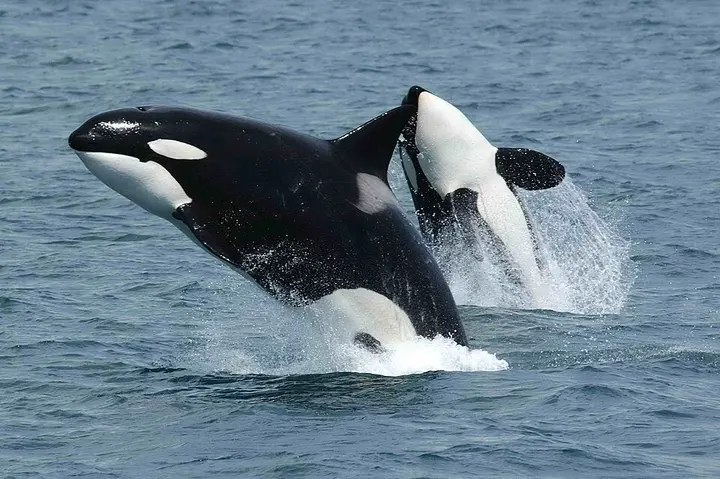
The orca, or killer whale, is a toothed whale and the largest member of the oceanic dolphin family. The only extant species in the genus Orcinus, it is recognizable by its distinct pigmentation; being mostly black on top, white on the bottom and having recognizable white eye patches. A cosmopolitan species, it inhabits a wide range of marine environments, from Arctic to Antarctic regions to tropical seas, but is more commonly documented in temperate or cooler coastal waters.
Scientists have proposed dividing the global population into races, subspecies, or possibly even species. Orcas are apex predators with a diverse diet. Individual populations often specialize in particular types of prey, including bony fish, sharks, rays, and marine mammals such as seals, dolphins, and whales. They are highly social, with some populations forming stable matrilineal family groups (pods). Their sophisticated hunting techniques and vocal behaviours, often unique to specific groups and passed down from generation to generation, are considered to be manifestations of animal culture. The most studied populations are off the west coast of North America, which include fish-eating "residents", mammal-eating "transients", and offshores.
Appearance
Orcas are the largest extant members of the dolphin family. Males typically range from 6 to 8 m (20 to 26 ft) long and weigh in excess of 6 t (5.9 long tons; 6.6 short tons). Females are smaller, generally ranging from 5 to 7 m (16 to 23 ft) and weighing about 3 to 4 t (3.0 to 3.9 long tons; 3.3 to 4.4 short tons). Orcas may attain larger sizes as males have been recorded at 10 m (33 ft) and females at 8.5 m (28 ft).
Behaviour
Day-to-day orca behaviour generally consists of foraging, travelling, resting and socializing. Orcas frequently engage in surface behaviour such as breaching (jumping completely out of the water) and tail-slapping. These activities may have a variety of purposes, such as courtship, communication, dislodging parasites, or play. Spyhopping is a behaviour in which a whale holds its head above water to view its surroundings.
Diet
Orcas are apex predators, meaning that they themselves have no natural predators. They are sometimes called "wolves of the sea", because they hunt in groups like wolf packs. Orcas hunt varied prey including fish, cephalopods, mammals, seabirds, and sea turtles. Different populations or ecotypes may specialize, and some can have a dramatic impact on prey species. However, whales in tropical areas appear to have more generalized diets due to lower food productivity.
Life cycle
Female orcas begin to mature at around the age of 10–13 and reach peak fertility around 20, experiencing periods of polyestrous cycling separated by non-cycling periods of three to 16 months. Females can often breed until age 40, followed by a rapid decrease in fertility. Orcas are among the few animals that undergo menopause and live for decades after they have finished breeding. The lifespans of wild females average 50 to 80 years.
Where the Orca lives
Recorded in United States of America, Canada, Antarctica, Norway, Fr. S. Antarctic Lands, United Kingdom, Chile, Ashmore and Cartier Is., Portugal, Iceland and Mexico (North America, Antarctica, Europe, Seven seas (open ocean), South America and Oceania).
Most records fall in Alaska, British Columbia, California, Washington, Troms and Nordland.
See the Orca’s range on the globe
Conservation status
Data deficient (DD). Scientists don’t have enough information yet to say how at risk it is. Categories are the IUCN Red List as republished by GBIF.
Sources
The range is a density of 36,170 georeferenced GBIF records, shown on the continents where it is mainly recorded, not an expert-drawn map. Description from Wikipedia.