Animals / Mammal
Okapi
Okapia johnstoni · Giraffidae
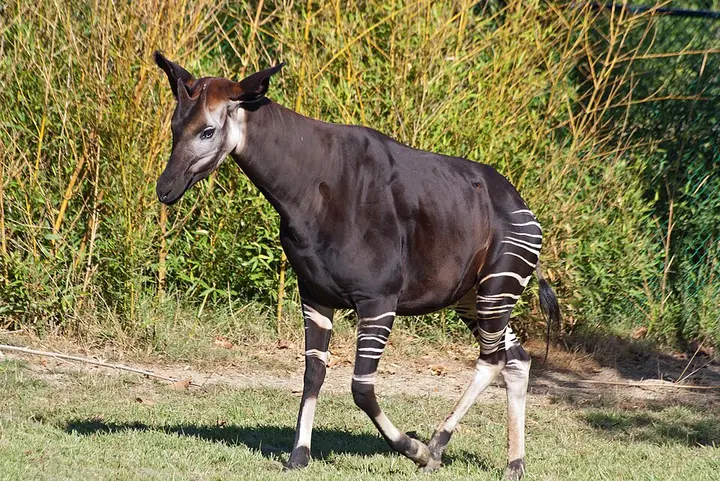
The okapi, also known as forest giraffe and zebra giraffe, is an artiodactyl mammal that is endemic to the northeast Democratic Republic of the Congo. However, non-invasive genetic identification has suggested that a population has occurred south-west of the Congo River as well. It is the only species in the genus Okapia.
Although the okapi has striped markings reminiscent of zebras, it is most closely related to the giraffe. The okapi and the giraffe are the only living members of the family Giraffidae. The okapi stands about 1.5 m (4 ft 11 in) tall at the shoulder and has a typical body length around 2.5 m (8 ft 2 in). Its weight ranges from 200 to 350 kg (440 to 770 lb). It has a long neck, and large, flexible ears. Its coat is a chocolate to reddish brown, much in contrast with the white horizontal stripes and rings on the legs, and white ankles. Male okapis have short, distinct horn-like protuberances on their heads called ossicones, less than 15 cm (5.9 in) in length. Females possess hair whorls, and ossicones are absent. Okapis are primarily diurnal, but may be active for a few hours in darkness.
Appearance
The okapi is a medium-sized giraffid, standing 1.5 m (4 ft 11 in) tall at the shoulder. Its average body length is about 2.5 m (8 ft 2 in) and its weight ranges from 200 to 350 kg (440 to 770 lb). It has a long neck, and large and flexible ears. In sharp contrast to the white horizontal stripes on the legs and white ankles, the okapi's coat is a chocolate to reddish brown. The distinctive stripes resemble those of a zebra.
Behaviour
Okapis are primarily diurnal, but may be active for a few hours in darkness. They are essentially solitary, coming together only to breed. They have overlapping home ranges and typically occur at densities around 0.6 animals per square kilometre. Male home ranges average 13 km2 (5.0 sq mi), while female home ranges average 3–5 km2 (1.2–1.9 sq mi). Males migrate continuously, while females are sedentary.
Diet
Okapis are herbivores, feeding on tree leaves and buds, branches, grasses, ferns, fruits, and fungi. They are unique in the Ituri Forest as they are the only known mammal that feeds solely on understory vegetation, where they use their 18-inch-long (46 cm) tongues to selectively browse for suitable plants. The tongue is also used to groom their ears and eyes. They prefer to feed in treefall gaps.
Habitat
The okapi is endemic to the Democratic Republic of the Congo, where it occurs north and east of the Congo River. It ranges from the Maiko National Park northward to the Ituri rainforest, then through the river basins of the Rubi, Lake Tele, and Ebola to the west and the Ubangi River further north. Smaller populations exist west and south of the Congo River. It is also common in the Wamba and Epulu areas. It is extinct in Uganda.
Where the Okapi lives
Recorded in Dem. Rep. Congo and Congo (Africa).
Most records fall in Orientale, Équateur, Nord-Kivu and Likouala.
See the Okapi’s range on the globe
Conservation status
Endangered (EN). In danger of dying out in the wild. Categories are the IUCN Red List as republished by GBIF.
Sources
The range is a density of 29 georeferenced GBIF records, shown on the continents where it is mainly recorded, not an expert-drawn map. Description from Wikipedia.