Animals / Bird
Northern mockingbird
Mimus polyglottos · Mimidae
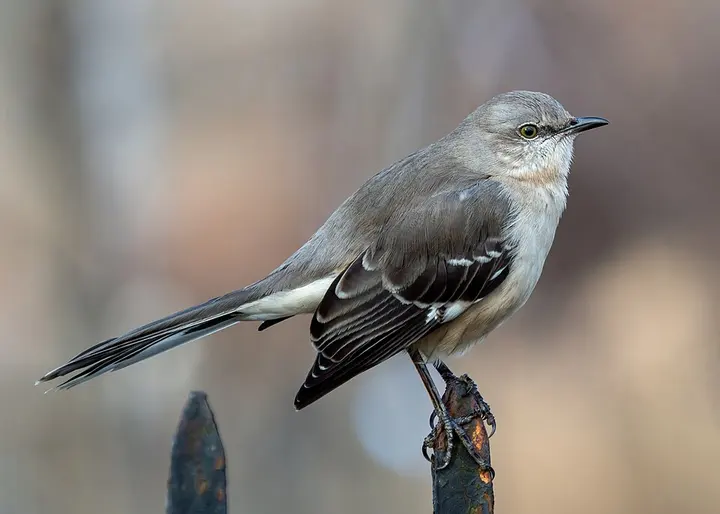
The northern mockingbird is a mockingbird commonly found in North America, of the family Mimidae. The species is also found in some parts of the Caribbean, as well as on the Hawaiian Islands. It is typically a permanent resident across much of its range, but northern mockingbirds may move farther south during inclement weather or prior to the onset of winter.
The northern mockingbird has gray to brown upper feathers and a paler belly. Its tail and wings have white patches which are visible in flight. The species is known for its ability to mimic bird calls and other types of sound, including artificial and electronic noises. Studies have shown its ability to identify individual humans and treat them differently based on learned threat assessments. It is an omnivore and consumes fruit, invertebrates, and small vertebrates. It is often found in open areas, open woodlands and forest edges, and is quite common in urbanized areas. The species breeds from southeastern Canada throughout the United States to the Greater Antilles. It is listed as a species of least concern by the International Union for Conservation of Nature.
Appearance
The northern mockingbird is a medium-sized mimid that has long legs and tail. Males and females look alike. Its upper parts are colored gray, while its underparts have a white or whitish-gray color. It has parallel wing bars on the half of the wings connected near the white patch giving it a distinctive appearance in flight. The black central rectrices and typical white lateral rectrices are also noticeable in flight.
Behaviour
The northern mockingbird is an omnivore. The birds' diet consists of arthropods (such as spiders, grasshoppers, wasps, bees, ants, beetles, butterflies, and caterpillars), earthworms, berries, fruits, seeds, and occasionally flowers, small crustaceans, and lizards (Anolis spp.). Mockingbirds can drink from puddles, river and lake edges, or dew and rain droplets that amass onto plants. Adult mockingbirds also have been seen drinking sap from the cuts on recently pruned trees.
Diet
The northern mockingbird is an omnivore. The birds' diet consists of arthropods (such as spiders, grasshoppers, wasps, bees, ants, beetles, butterflies, and caterpillars), earthworms, berries, fruits, seeds, and occasionally flowers, small crustaceans, and lizards (Anolis spp.). Mockingbirds can drink from puddles, river and lake edges, or dew and rain droplets that amass onto plants. Adult mockingbirds also have been seen drinking sap from the cuts on recently pruned trees.
Habitat
The mockingbird's breeding range is from the Maritime provinces of southern Canada, westwards to southern Oregon, and south through practically the entire continental United States south of the northern Plains states and Pacific Northwest, the Greater Antilles, and the majority of Mexico to eastern Oaxaca and Veracruz.
Where the Northern mockingbird lives
Recorded in United States of America (North America).
Most records fall in Texas, Florida, California, Virginia, North Carolina and Maryland.
See the Northern mockingbird’s range on the globe
Conservation status
Least concern (LC). Not at risk: it is doing well in the wild. Categories are the IUCN Red List as republished by GBIF.
Sources
The range is a density of 11,849,394 georeferenced GBIF records, shown on the continents where it is mainly recorded, not an expert-drawn map. Description from Wikipedia.