Animals / Bird
Northern flicker
Colaptes auratus · Picidae
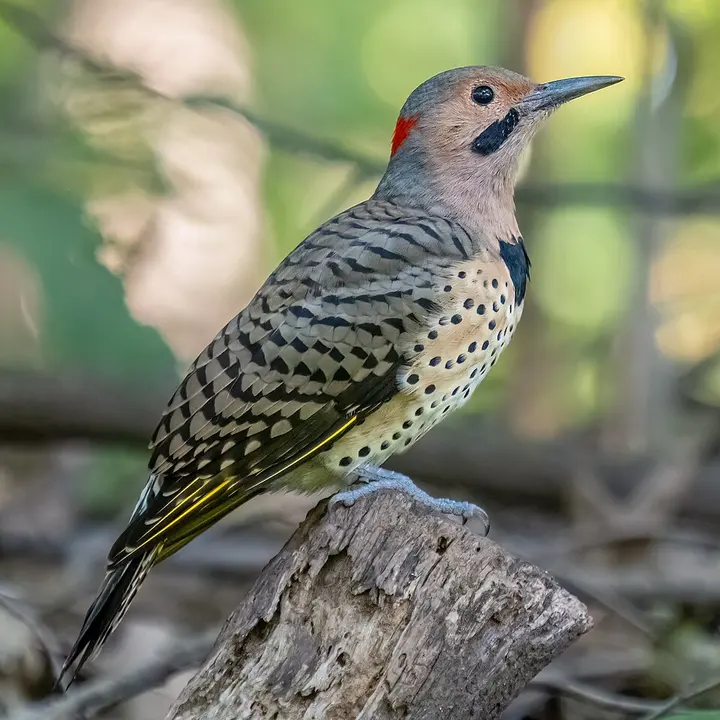
The northern flicker or common flicker is a medium-sized bird of the woodpecker family. It is native to most of North America, parts of Central America, Cuba, and the Cayman Islands, and is one of the few woodpecker species that migrate. Over 100 common names for the northern flicker are known, including yellowhammer, clape, gaffer woodpecker, harry-wicket, heigh-ho, wake-up, walk-up, wick-up, yarrup, and gawker bird.
Many of these names derive from attempts to imitate some of its calls.
Appearance
Adults are brown with black bars on the back and wings. A mid- to large-sized northern flicker measures 28–36 cm (11–14 in) in length and 42–54 cm (16+1⁄2–21+1⁄2 in) in wingspan. The body mass can vary from 86 to 167 g (3 to 5+7⁄8 oz). Among standard scientific measurements, the wing bone measures 12.2–17.1 cm (4+13⁄16–6+3⁄4 in), the tail measures 7.5–11.5 cm (3–4+1⁄2 in), the bill measures 2.2–4.3 cm (7⁄8–1+11⁄16 in) and the tarsus measures 2.2–3.1 cm (7⁄8–1+1⁄4 in).
Diet
According to the Audubon field guide, "flickers are the only woodpeckers that frequently feed on the ground", probing with their beak, also sometimes catching insects in flight. Although they eat fruits, berries, seeds, and nuts, their primary food is insects. Ants alone can make up 45% of their diet. Other invertebrates eaten include flies, butterflies, moths, beetles, and snails.
Habitat
The northern flicker may be observed in open habitats near trees, including woodlands, edges, yards, and parks. In the western United States, one can find it in mountain forests all the way up to the tree line. The northern flicker generally nests in holes in trees like other woodpeckers. Occasionally, it has been found nesting in old, earthen burrows vacated by belted kingfishers (Megaceryle alcyon) or sand martins (Riparia riparia).
Life cycle
The northern flicker's breeding habitat consists of forested areas across North America and as far south as Central America. It is a cavity nester that typically nests in trees, but may also use posts and birdhouses if sized and situated appropriately. It prefers to excavate its own home, although it may reuse and repair damaged or abandoned nests. Often the old nests are created by belted kingfishers or sand martins.
Where the Northern flicker lives
Recorded in United States of America and Canada (North America).
Most records fall in California, Washington, New York, British Columbia, Colorado and Oregon.
See the Northern flicker’s range on the globe
Conservation status
Least concern (LC). Not at risk: it is doing well in the wild. Categories are the IUCN Red List as republished by GBIF.
Sources
The range is a density of 15,030,649 georeferenced GBIF records, shown on the continents where it is mainly recorded, not an expert-drawn map. Description from Wikipedia.