Animals / Bird
Northern cardinal
Cardinalis cardinalis · Cardinalidae
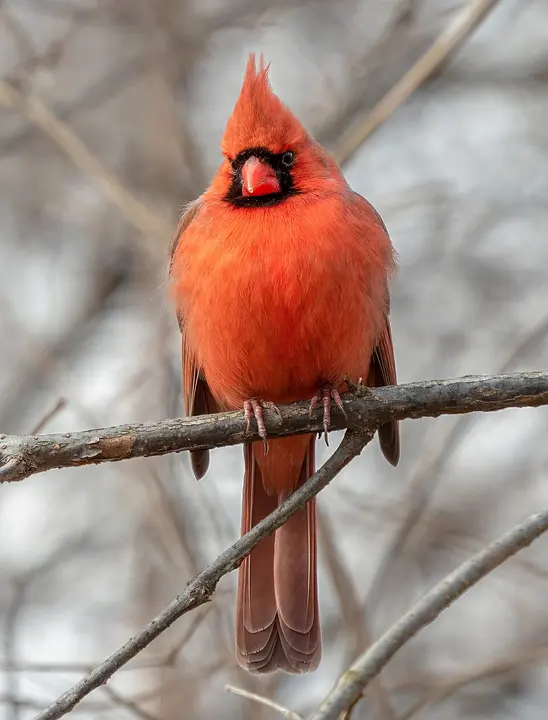
The northern cardinal, also commonly known as the common cardinal, red cardinal, or simply cardinal, is a bird in the genus Cardinalis. It can be found in southeastern Canada, through the eastern United States from Maine to Minnesota to Texas, New Mexico, southern Arizona, southern California and south through Mexico, Belize, and Guatemala. It is also an introduced species in a few locations such as Bermuda and all major islands of Hawaii since its introduction in 1929.
Its habitat includes woodlands, gardens, shrublands, and wetlands. It is the state bird of Illinois, Indiana, Kentucky, North Carolina, Ohio, Virginia, and West Virginia. The northern cardinal is a mid-sized perching songbird with a body length of 21–23 cm (8.3–9.1 in) and a crest on the top of its head. The species expresses sexual dimorphism: Females are a reddish olive color, and have a gray mask around the beak, while males are a vibrant red color, and have a black mask on the face, as well as a larger crest. Juvenile cardinals do not have the distinctive red-orange beak seen in adult birds until they are almost fully mature. On hatching, their beaks are grayish-black and they do not become the typical orange-red color until they acquire their final adult plumage in the fall.
Appearance
The northern cardinal is a mid-sized songbird with a body length of 21–23.5 cm (8.3–9.3 in) and a wingspan of 25–31 cm (9.8–12.2 in). The adult weighs from 33.6–65 g (1.19–2.29 oz), with an average 44.8 g (1.58 oz). The male averages slightly larger than the female. The oldest wild cardinal banded by researchers lived at least 15 years and 9 months, although 28.5 years was achieved by a captive bird.
Behaviour
During winter, cardinals will fluff up their down feathers in order to retain warm air next to their body. The down feathers are small and hairlike at the base of each flight feather. The legs and feet are thin and lack feathers, and are vulnerable to rapid heat loss. In cold temperatures, cardinals will shiver and tense their muscles, especially breast muscles, to generate heat.
Diet
The diet of the adult northern cardinal consists mainly (up to 90%) of weed seeds, grains, and fruits. It is a ground feeder and finds food while hopping on the ground through trees or shrubbery. It will also consume snails and insects, including beetles, cicadas, and grasshoppers, and the young are fed almost entirely on insects. Other common items include corn, oats, sunflower seeds, the blossoms and bark of elm trees, and drinks of maple sap from holes made by sapsuckers.
Habitat
Northern cardinals are numerous across the eastern United States from the southern half of Maine to Minnesota to the Texas-Mexico border and in Canada in the southern portions of Ontario, Quebec, New Brunswick and Nova Scotia, all the way east to Cape Breton Island. Its range also extends south through Mexico to the Isthmus of Tehuantepec, northern Guatemala, and northern Belize.
Where the Northern cardinal lives
Recorded in United States of America and Canada (North America).
Most records fall in Texas, New York, Florida, Pennsylvania, Ontario and Virginia.
See the Northern cardinal’s range on the globe
Conservation status
Least concern (LC). Not at risk: it is doing well in the wild. Categories are the IUCN Red List as republished by GBIF.
Sources
The range is a density of 27,231,609 georeferenced GBIF records, shown on the continents where it is mainly recorded, not an expert-drawn map. Description from Wikipedia.