Animals / Bird
North Island brown kiwi
Apteryx mantelli · Apterygidae
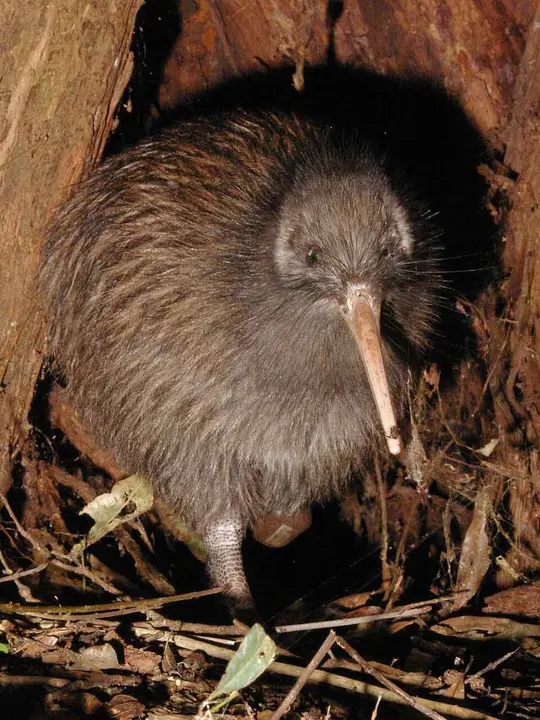
The North Island brown kiwi is a nocturnal flightless bird and species of kiwi that is widespread in the northern two-thirds of the North Island of New Zealand and, with about 35,000 remaining, it is the most common kiwi species. The eggs laid by the North Island brown kiwi are among the largest eggs relative to its body size.
Appearance
It is a large brown kiwi, possessing spiky, streaked feathers. North Island brown kiwi display size-based sexual dimorphism, where the females are observably larger than the males. The males weigh between 1.44–3.06 kg (3.2–6.7 lb) and females weigh between 2.06–3.85 kg (4.5–8.5 lb). The long bill measures 13–20.5 cm (5.1–8.1 in) in length.
Behaviour
Kiwi species, such as the North Island brown kiwi, have been found to allocate the majority of their time to foraging, as compared to other behaviours such as vigilance, walking, socialising etc. Their diet primarily consists of invertebrate species, including spiders and worms, which make up 85–95% of their intake, with plant material comprising the remainder.
Diet
Kiwi species, such as the North Island brown kiwi, have been found to allocate the majority of their time to foraging, as compared to other behaviours such as vigilance, walking, socialising etc. Their diet primarily consists of invertebrate species, including spiders and worms, which make up 85–95% of their intake, with plant material comprising the remainder.
Where the North Island brown kiwi lives
Recorded in New Zealand (Oceania).
Most records fall in Northland, Auckland, Waikato, Taranaki, Manawatu-Wanganui and Bay of Plenty.
See the North Island brown kiwi’s range on the globe
Conservation status
Vulnerable (VU). At risk: it could become endangered. Categories are the IUCN Red List as republished by GBIF.
Sources
The range is a density of 3,038 georeferenced GBIF records, shown on the continents where it is mainly recorded, not an expert-drawn map. Description from Wikipedia.