Animals / Mammal
North American river otter
Lontra canadensis · Mustelidae
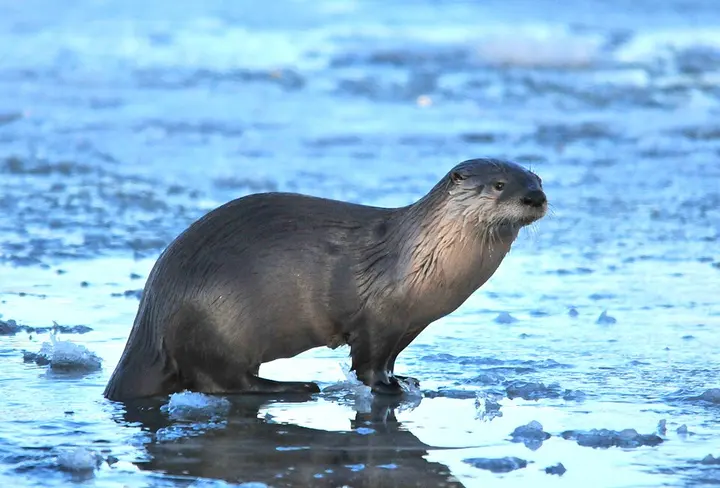
The North American river otter, also known as the northern river otter and river otter, is a semiaquatic mammal that is endemic to the North American continent throughout most of Canada and along the coasts of the United States and its inland waterways. An adult North American river otter can weigh between 5 and 14 kilograms (11–31 lb). The river otter is protected and insulated by a thick, water-repellent coat of fur.
The North American river otter, a member of the subfamily Lutrinae in the weasel family (Mustelidae), is equally versatile in the water and on land. It establishes a burrow close to the water's edge in river, lake, swamp, coastal shoreline, tidal flat, or estuary ecosystems. The den typically has many tunnel openings, one of which generally allows the otter to enter and exit the body of water. Females give birth in these burrows, producing litters of one to six young. North American river otters, like most predators, prey upon the most readily accessible species. Fish is a favored food among the otters, but they also consume various amphibians (such as salamanders and frogs), freshwater clams, mussels, snails, small turtles, and crayfish.
Appearance
The North American river otter has long and thin whiskers that are used to detect prey in dark waters. An average adult male weighs about 11.3 kilograms (25 lb) against the female's average of 8.3 kg (18 lb). Its body length ranges from 66 to 107 cm (26–42 in). About one-third of the animal's total length consists of a long, tapered tail. Tail lengths range from 30 to 50 cm (12–20 in). Large males can exceed a weight of 15 kg (33 lb).
Behaviour
North American river otters only settle in areas that consist of vegetation, rock piles, and sufficient coverage.
Diet
A highly active predator, the North American river otter has adapted to hunting in water and eats aquatic and semiaquatic animals. The vulnerability and seasonal availability of prey animals mainly governs its food habits and prey choices.
Habitat
The North American river otter is found throughout North America, inhabiting inland waterways and coastal areas in Canada, the Pacific Northwest, the Atlantic states, and states on the Gulf of Mexico. They also inhabit the forested regions near the Pacific coast in North America. The species is also present throughout Alaska, including the Aleutian Islands, and the north slope of the Brooks Range.
Where the North American river otter lives
Recorded in United States of America and Canada (North America).
Most records fall in California, British Columbia, Ontario, Florida, Washington and Texas.
See the North American river otter’s range on the globe
Conservation status
Least concern (LC). Not at risk: it is doing well in the wild. Categories are the IUCN Red List as republished by GBIF.
Sources
The range is a density of 27,768 georeferenced GBIF records, shown on the continents where it is mainly recorded, not an expert-drawn map. Description from Wikipedia.