Animals / Mammal
North American porcupine
Erethizon dorsatus · Erethizontidae
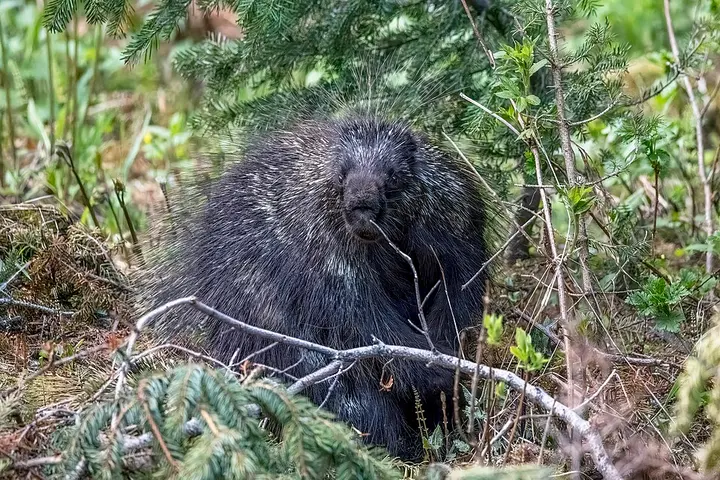
The North American porcupine, also known as the Canadian porcupine, is a large quill-covered rodent in the New World porcupine family. It is the second largest rodent in North America after the North American beaver. The porcupine is a caviomorph rodent whose ancestors were believed to have crossed the Atlantic from Africa to Brazil 30 million years ago, and then migrated to North America during the Great American Interchange after the Isthmus of Panama rose 3 million years ago.
Appearance
Porcupines are usually dark brown or black in color, with white highlights. They have a stocky body, a small face, short legs, and a short, thick tail. This species is the largest of the New World porcupines and is the second largest rodent endemic to North America, after the American beaver (the Lesser capybara, which is larger, does range into North American Panama, but mostly occurs in South America).
Behaviour
Porcupines are herbivores. During the summer, North American porcupines eat twigs, roots, stems, fruits, leaves, and other vegetation. In the winter, they eat mainly conifer needles and tree bark. Porcupines are selective in their consumption, but the degree of selectivity depends on the season.
Diet
Porcupines are herbivores. During the summer, North American porcupines eat twigs, roots, stems, fruits, leaves, and other vegetation. In the winter, they eat mainly conifer needles and tree bark. Porcupines are selective in their consumption, but the degree of selectivity depends on the season.
Habitat
In eastern North America, porcupines range from Canada to the Appalachian Mountains in West Virginia and Maryland, though east of the Appalachians their range extends no farther south than northern New Jersey. In the west they range from Alaska to northern mountains in Mexico. They are commonly found in coniferous and mixed forested areas, but have adapted to harsh environments, such as shrublands and tundra. They make their dens in hollow trees or in rocky areas.
Life cycle
Female porcupines are solitary for most of the year except during the fall when breeding season begins. At this time, they secrete thick mucus that mixes with urine, producing an odor attracting nearby males. The male typically sits in a tree below the female. If another male approaches, they may fight for mating rights. Once a dominant male succeeds, he approaches and sprays urine on the female, causing her to enter estrus.
Where the North American porcupine lives
Recorded in United States of America and Canada (North America).
Most records fall in Ontario, Texas, Vermont, Québec, New York and Alberta.
See the North American porcupine’s range on the globe
Conservation status
Least concern (LC). Not at risk: it is doing well in the wild. Categories are the IUCN Red List as republished by GBIF.
Sources
The range is a density of 26,293 georeferenced GBIF records, shown on the continents where it is mainly recorded, not an expert-drawn map. Description from Wikipedia.