Animals / Mammal
North American beaver
Castor canadensis · Castoridae
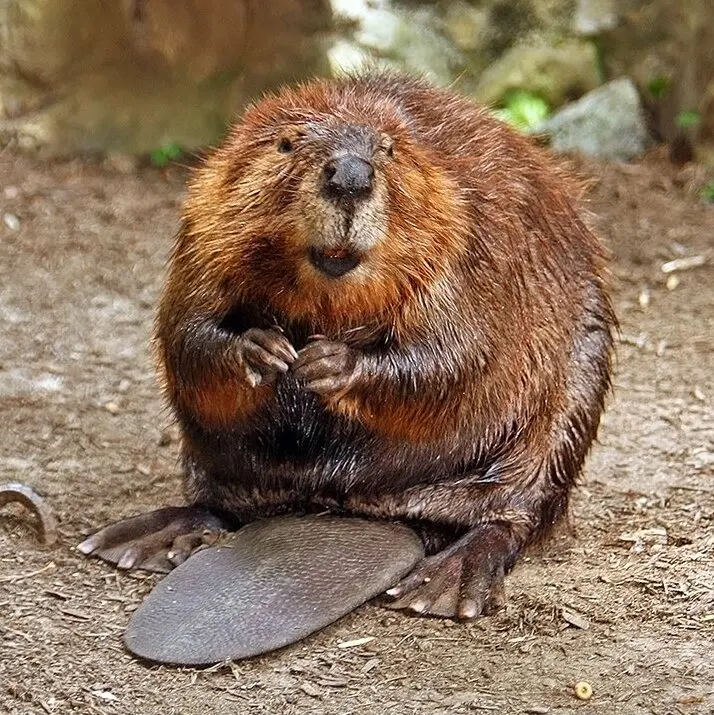
The North American beaver is one of two extant beaver species, along with the Eurasian beaver. It is native to North America and has been introduced in South America (Patagonia) and Europe. The North American beaver is one of the national symbols of Canada and the official state mammal of Oregon and New York.
North American beavers are widespread across the continental United States, Canada, southern Alaska, and some parts of northern Mexico. In Canada and the United States, the North American beaver is often referred to simply as "beaver;" however, this can cause some confusion because another distantly related rodent, Aplodontia rufa, is often called the "mountain beaver". Other vernacular names, including American beaver and Canadian beaver, distinguish this species from the other extant beaver species, Castor fiber, which is native to Eurasia.
Appearance
The beaver is the largest rodent in North America and competes with its Eurasian counterpart, the European beaver, for being the third-largest in the world, both following the South American capybara and lesser capybara. The European species is slightly larger on average but the American has a larger known maximum size. Adults usually weigh from 11 to 32 kg (24 to 71 lb), with 20 kg (44 lb) being typical.
Behaviour
Beavers are active mainly at night. They are excellent swimmers and may remain submerged up to 15 minutes. More vulnerable on land, they tend to remain in the water as much as possible. They use their flat, scaly tail both to signal danger by slapping the surface of the water and as a location for fat storage. They construct their homes, or "lodges", out of sticks, twigs, rocks, and mud in lakes, streams, and tidal river deltas.
Diet
Beavers are herbivorous generalists with sophisticated foraging preferences based on taste, coarse physical shape, and odor. Beavers consume a mix of herbaceous and woody plants, which varies considerably in both composition and species diversity by region and season. Beavers feed on bark, cambium, branches, twigs, roots, buds, leaves, stems, sprouts, and in some cases, sap and storax.
Habitat
Beavers were practically ubiquitous and lived from south of the arctic tundra to the deserts of northern Mexico, and from the Atlantic to the Pacific Oceans, but were trapped across the continent for economic gain and political competition, leading to regional extirpation in many regions like the Great Plains.
Life cycle
North American beavers have one litter per year, coming into estrus for only 12 to 24 hours, between late December and May but peaking in January. Beaver reproduction occurs earlier in warmer southern climates, however in their northern range beavers may wait until late spring to reproduce. Depending on when beavers reproduce, their litters are typically born between April and June each year.
Where the North American beaver lives
Recorded in United States of America and Canada (North America and South America).
Introduced, not native, in Chile.
Most records fall in Magallanes y Antártica Chilena, Ontario, Oregon, British Columbia, Texas and Alberta.
See the North American beaver’s range on the globe
Conservation status
Least concern (LC). Not at risk: it is doing well in the wild. Categories are the IUCN Red List as republished by GBIF.
Sources
The range is a density of 99,589 georeferenced GBIF records, shown on the continents where it is mainly recorded, not an expert-drawn map. Description from Wikipedia.